Earth Day, 22 April, is a reminder that many countries have already consumed their lot of annual resources in April or May and are living beyond their means at the expense of others. This year’s motto “Our Power, Our Planet” draws attention to the agency all people have to change things together for the better.
Mundus maris therefore invited to a webinar on 12 May that put the emphasis on what advances can be observed at ground level and how they may encourage other to help scale such opportunities, adapting them to their specific context. Prof. Stella Williams of Mundus maris was the moderator.
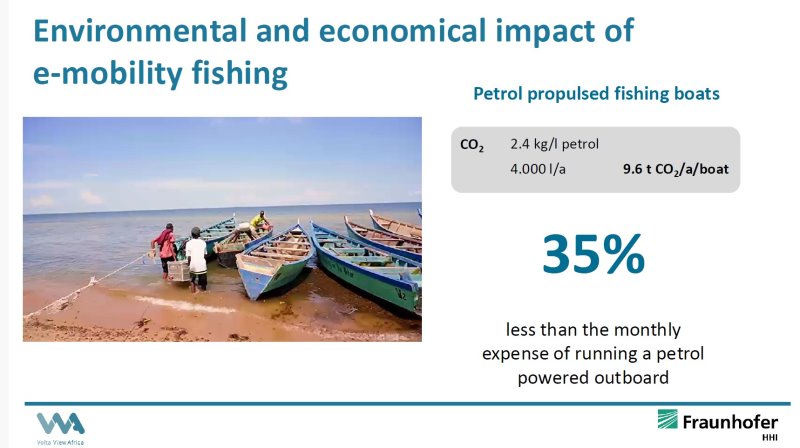
First to speak was Prof. Wolfgang Schade of the Fraunhofer Institute HHI and VoltaviewAfrica. His focus was on successful examples of solar minigrids to help provide electricity under local control to a series of practical applications that can prolong study times in the evening, reduce back-breaking manual work for women in a money-making electric laundry, and electric mobility of inland waters for fishing and transport.
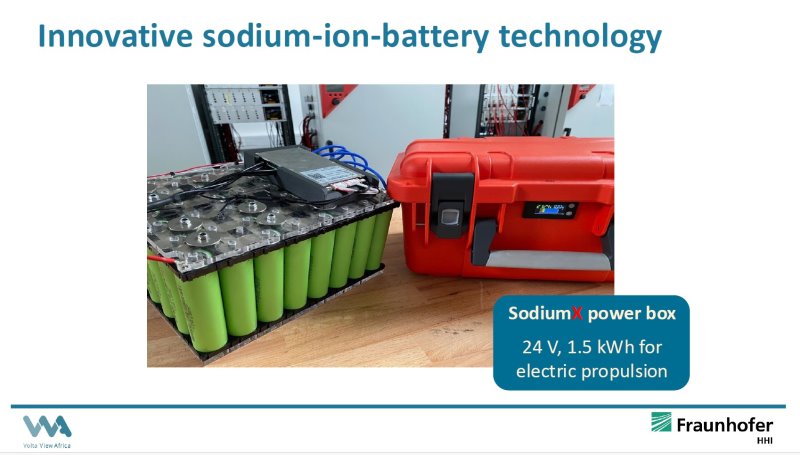
He went on to illustrate the advantages of new sodium-ion batteries to store solar energy for times when the sun does not shine. These don’t rely on expensive lithium like conventional batteries but use readily available sodium. Individual cells get delivered from China and are assembled in Tanzania to complete batteries, protected by purpose made cases that allow use on the water and elsewhere.
VoltaviewAfrica was collaborating with a local firm to expand and set up the first assembly line of sodium-ion batteries in Africa. Training and various forms of capacity building were part of the collaboration to ensure short-to medium-term autonomy for maintenance, repair and expansion of applications. The slides are available here.
All were keen to hear more from Kazeem Olayinka of the Mundus maris group in Nigeria about advances in training up interested people in the villages around Lagos how to process themselves the over-abundant water hyacinth and other invasive plants into useful applications. Alas, the network failed him and he could not connect. Catch a glimpse of the opportunities creating the excitement in the short report about an initial demonstration workshop.
The moderator thus called on Cornelia E Nauen to talk about the Small-Scale Fisheries (SSF) Academy’s role in strengthening the capacities of men and women in SSF to engage in ocean governance with a focus on West Africa. This initiative started to support the operationalisation of the Voluntary Guidelines to Ensure Sustainable SSF in the context of food security and poverty eradication. It had become urgent as the unfair competition between export oriented industrial fishing with artisanal fisheries. Hundreds of thousands of people depended on the latter for their livelihoods and the development of a strong local and regional economy as well as food security particularly of people with little money. Centralised management systems generally not providing pathways for active participation of small-scale fishers, men and women, typically lead to management failures, because they pick up signals of overfishing late and tend to prefer notions of industrial activities over less structured and distributed artisanal activities. That means the fishers’ ecological knowledge with finer spatial and temporal resolution than what occasional scientific surveys can produce has no place in the decision making process.
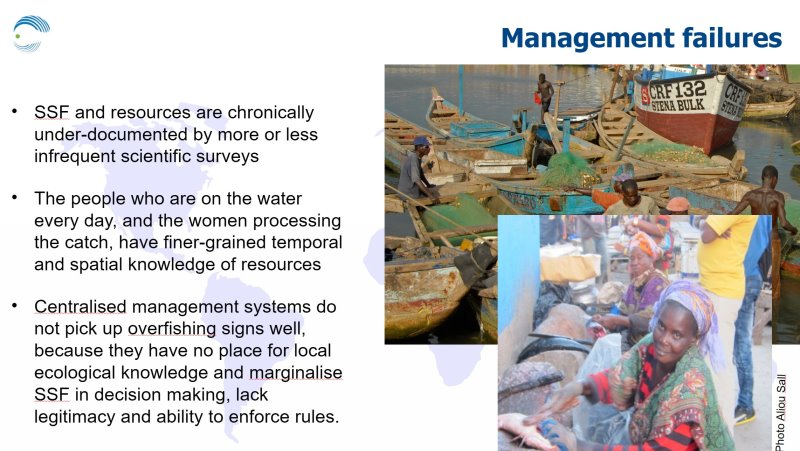
Being mostly excluded, small-scale fishers and the women handling and marketing catches do not feel bound by management decisions operating, as they typically do, in the informal economy without formal recognition and access to most social support services.
To change this for the better in the spirit of the SSF Guidelines adopted by the FAO Committee of Fisheries in 2014 Mundus maris launched the SSF Academy with men and women of all ages, professions and regions across Senegal in 20218. In a series of pilot activities inclusive participatory methods were adjusted and successfully tested in two fishing villages. While the pandemic starting in early 2020 put an end to some of the support for strengthening the groups’ capacities for collective action and outreach to other groups as originally intended, it did build significant self confidence and organisational capacity that shows til today. The central tenet is to provide a safe space for respectful dialogue, where everybody is welcome and nobody is judged. Academy participants are invited to learn and innovate together and, indeed found renewed trust and agency to advance the legitimate demands of their groups.
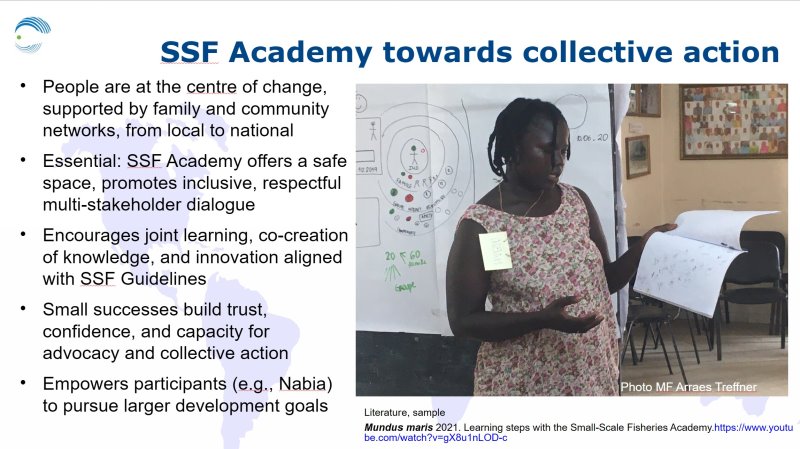
An early example is shown in this video with footage from Nabia Ngom, one of the successful users of what she learned at the Academy.
Mundus maris is open to support groups elsewhere with the Academy methodology adapted to their local context and focused on creating sufficient local capacity to share and amplify with others to enable broader-based local action towards co-governance and better outcomes for people and planet. The slides are available here.
The lively Q&A part of the webinar ascertained the interest in these activities from the ground up. They show the way for cheaper and better solutions to widespread problems across Africa that are still holding people’s development back. Opportunities abound, it’s time to use them to the fullest thanks to local and international cooperation.
Accademia della Pesca Artigianale
- The SSF Academy convenes the second workshop in Ghana
- Mundus maris presents the SSF Academy in Ghana at the 3rd SSF Summit in Rome
- Restoring Ghana’s fisheries starts with the people who depend on them
- Small-Scale fisheries should be a big part of the future in West Africa
- Plunder in the Atlantic: When Overfishing Threatens the Sea and Coastal Communities
- Our Power, Our Planet – Celebrating Earth Day Webinar
- Mundus maris all’EGU26, 3-8 maggio 2026
- Mundus maris at the aspirational 5th World SSF Summit, Thailand
- Trasformare un’erbaccia acquatica in una fonte di reddito
- Pescatori artigianali e ambientalisti ripensano insieme la pesca
- Make Fishing Fair
- La pesca eccessiva straniera alimenta la mortale crisi migratoria del Senegal verso l’Europa
- Mundus maris at MARE 2025
- I pescatori artigianali al centro della governance dell’oceano e della sicurezza alimentare
- Make Fishing Fair in the EU, 25 March 2025
- Human – Biodiversity Relationships Across Scales
- World Fisheries Day, 21 November 2024, celebrated in Nigeria
- Mundus maris partecipa al 2024 World Fisheries Day organizzato dalla Canoe and Fishing Gear Association del Ghana (CaFGOAG).
- Mundus maris contribution to the UNOC3 public consultation
- Vertice sulla pesca artigianale a Roma, 5-7 luglio 2024
- Regional Symposium on European Small-Scale Fisheries, Larnaca, Cyprus, 1-3 July 2024
- Riunione di emergenza sulla pesca nel Baltico, Bruxelles, 26 giugno 2024
- Ambivalent role of Market and Technology in the Transitions from Vulnerability to Viability: Nexus in Senegal SSF
- Shell fisheries as stewardship for mangroves
- Giornata mondiale della pesca, 21 novembre 2023
- Webinar: Nigeria’s Fisheries challenges and opportunities
- Presentazione della FishBase app al Symposium di Tervuren
- Convegno MARE sulla paura blu – Mundus maris riflette
- The Transition From Vulnerability to Viability Through Illuminating Hidden Harvests, 26 May 2023
- Sessioni EGU focalizzate su geoetica e apprendimento congiunto
- Solidarietà con i pescatori artigianali in Senegal e Mauritania
- The legal instruments for the development of sustainable small-scale fisheries governance in Nigeria, 31 March 2023
- Tools for Gender Analysis: Understanding Vulnerability and Empowerment, 17 February 2023
- Community resilience: A framework for non-traditional field research, 27 January 2023
- Sustainability at scale – V2V November webinar
- Edizione africana del 4WSFC a Cape Town, 21-23/11/22
- Edizione Europea del 4WSFC in Malta, 12-14 Settembre 2022
- Mundus maris contribuisce all’SSF Summit in Roma
- Donne commercianti di pesce a Yoff e Hann in Senegal, vittime o artefici del loro destino?
- L’Accademia continua il suo lavoro a Yoff
- Illuminating the Hidden Harvest – a snapshot
- Virtual launch event FAO: International Year of Artisanal Fisheries and Aquaculture
- The Small-Scale Fisheries Academy as a source of operational support to PA Guidelines
- Congresso mondiale della pesca, Adelaide, 20-24 settembre
- Mundus maris sostiene la lotta di Paolo il pescatore, in Toscana, Italia
- Catching-up – SSF Academy Yoff, 27 Febr. 2021
- Rafforzare le capacità degli attori per una pesca sostenibile su piccola scala
- Sperimentazione dei metodi di formazione durante la fase pilota dell’Accademia SSF in Senegal
- Una prima assoluta: il lancio di un’Accademia della Pesca su Piccola Scala in Senegal