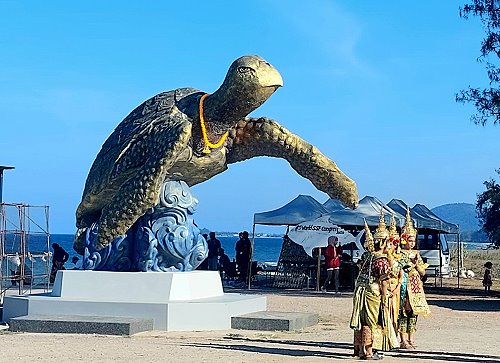
Excursion to the coastal fishing village of Bang Saphan
“Small-Scale Fisheries for Advancing Just Harmony, Young Futures & Regenerative Wisdom” was the motto of the fifth World Small-Scale Fisheries Congress convened from 27 April to 1 May 2026 in Hua Hin, Thailand. Since 2010 the global research network ‘Too Big To Ignore’, led by Ratana Chuenpagdee, organises these opportunities to connect, collaborate, and set the stage for future global actions to support viable and sustainable small-scale fisheries.
Some 250 researchers, practitioners, fishers and civil society representatives gathered to present results of their work, learn from one another, and explore new activities in favour of making small-scale, low impact, fisheries central to regenerating the ocean and inland waterways for food and livelihoods. This entails working with nature rather than continuing on a pathway of ever more sophisticated, destructive, and costly industrial extractions.
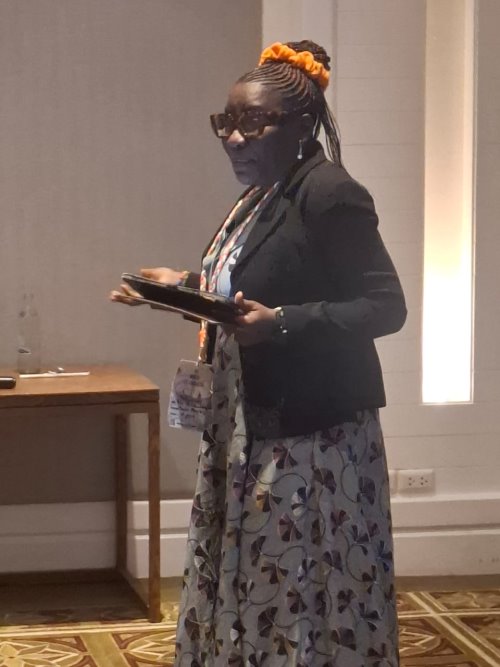
Ayojesutomi Abiodun-Solanke presenting the research on behalf of the entire group on day 1
Right on the first day, Ayojesutomi Abiodun-Solanke presented the first contribution by Mundus maris titled ‘Women in small-scale fisheries: victims or architects of their destiny?’, a joint paper by CE Nauen, S. Williams, A. Sall, A. Abiodun-Solanke, K.A. Fakoya and S. Appiah.
The research traces the challenges to women in SSF with emphasis on West Africa, where a combination of industrial overfishing, turning food fish into fish meal and oil, and lack of access formal credit and social services risk to drive many selectively into poverty – with dire consequences for their children and families.
The paper also testifies to the creativity and perseverance of the women to defend their rights. It pleads for gender equity and the more generalised implementation of the ‘Voluntary Guidelines for Ensuring Sustainable Small-Scale Fisheries in the context of food security and poverty eradication’ adopted by the FAO Fisheries Committee (COFI) in 2014.
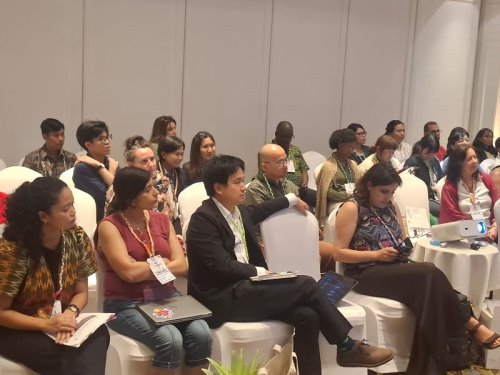
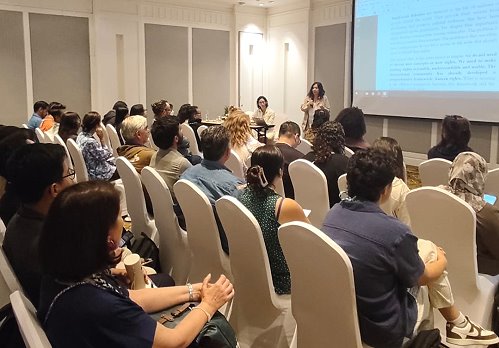
The audience listening attentively to Tomi’s talk
Increasing women’s access to education and investing in organisational strengthening are critical and effective. Through an early effort thanks to the Small-Scale Fisheries Academy based on respectful multi-stakeholder dialogue in Senegal, we observed improved individual and collective confidence in their agency.
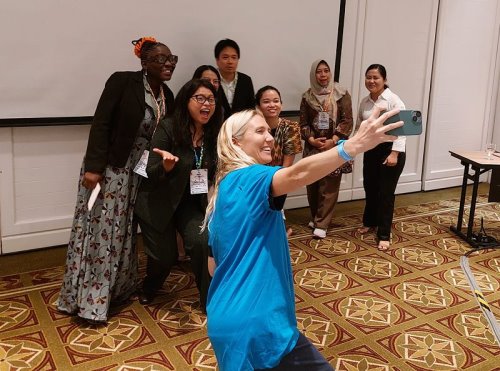
Enthusiastic speakers posing after the session
When political leaders enter into dialogue with small-scale fishers and their organisations, they create potential for amplification of local initiatives as is e.g. in Ghana – where the new woman minister dialogues with small-scale fisher organisations and has extended the exclusion zone keeping out industrial trawlers from 6 to 12 nautical miles.
Meanwhile in Senegal, REFEPAS (Réseau des femmes dans la pêche artisanale du Sénégal), the women’s network, is in frequent dialogue with the woman minister in charge of fisheries of the new government, but still have not obtained an official recognition of their professional status.
The slides of the presentation are available here.
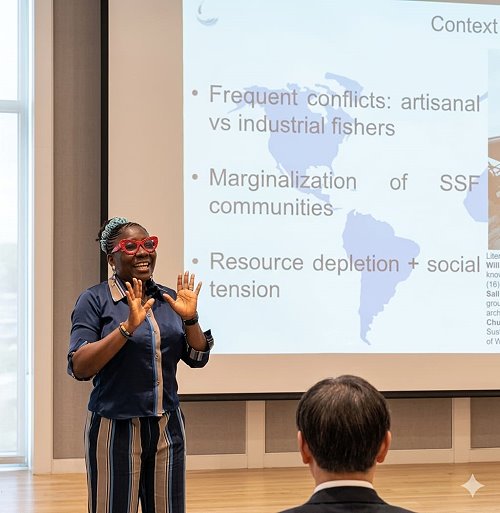 On day 2, it was again the turn of Tomi to share a short communication, this time with a focus on her native Nigeria.
The contribution ‘Indigenous Stewardship: A Catalyst for Driving Conflict Resolution in Nigerian Coastal Communities’ focused on the vital role of traditional knowledge and community-led governance in mitigating resource-based disputes.
In her energetic, yet friendly, way, she insisted on the need to recognise traditional and small-scale communities who had considerable ecological and practical knowledge allowing them to persist despite often unfavourable conditions and institutional neglect.
Both presentations generated a significant volume of positive reactions, with participants engaging in extensive discussions praising the practical frameworks offered for addressing conflict and gender equity.
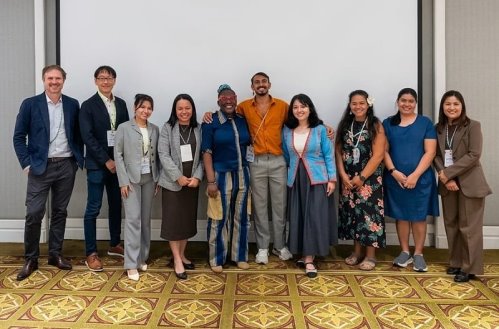
Speakers of the particularly international session
The congress also facilitated a formal integration into the Too Big To Ignore (TBTI) global research network and the Nigerian SSF member group.
A key highlight was the participation in the inaugural sessions of the just-formalised African Hub.
Through these engagements, the association’s presence was solidified within a unified continental framework. This integration ensures that Mundus maris is positioned to contribute even more to coordinated advocacy efforts across Africa, fostering stronger ties with regional partners and enhancing the collective voice of small-scale fishers in policy-making processes.
Significant progress was achieved regarding the Global Fisheries Research Program (GFRP) Innovation Fund developed in collaboration with a Cornell University PhD student collaborating with the Justice and Empowerment Initiative (JEI). Extensive work was carried out on a project proposal in collaboration with JEI and other partners. The initial Letter of Intent (LOI) was successfully shortlisted by the selection committee, marking a transition to the full proposal stage. The final submission is required by May 22, 2026. This project is expected to deepen the association’s work with JEI, focusing on empowering marginalised coastal residents through innovative research and legal empowerment.
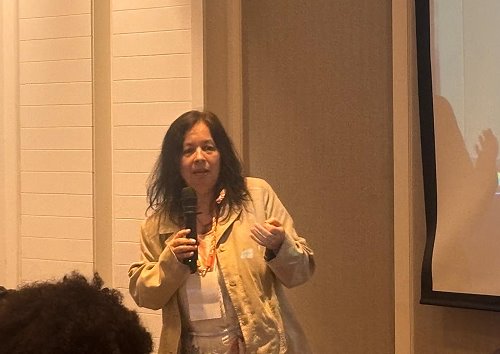
Patricia Morales during her talk
Then it was the turn of Maria del Carmen Patricia Morales how presented her reflections on ‘Regenerative Wisdom, Human Rights, and Circular Culture: Safeguarding Pirogues as Intangible Heritage in West Africa’.
On day 3 Patricia noted a paradox: many fishers remain unable to realize their basic human rights: access to adequate nutrition, health, education, decent remuneration, social protection, and security of their freedom and integrity. In contexts where insecurity grows rather than diminishes, questions arise: are SSF truly sustainable, when fishers remain in precarious conditions – not out of free choice, but due to the absence of alternatives?
External actors often focus on gains from this vulnerability, marginalising fishers and treating artisanal traditions as obstacles to industrial exploitation.
 Against this backdrop, a different perspective emerges: valuing culture not as a mirror of imperialism, but as a universal expression grounded in human rights. Intangible cultural heritage (ICH), as advanced by UNESCO, innovatively links safeguarding traditions with ethical responsibility: no aesthetics has meaning, if it contradicts human rights.
The artistry of pirogues exemplifies this convergence. Their intrinsic value lies not only in their craftsmanship and symbolism but also in their potential to strengthen the dignity and rights of fishers. Misuse of pirogues for unsafe oceanic migration or their destruction in the Canary Islands reveals a profound imbalance. Reframing pirogues as living heritage—through education, training, and respectful tourism — can regenerate wisdom and resilience.
We propose exploring the viability of nominating these pirogues as ICH under special safeguarding measures, with a triple impact: protecting fishers’ rights, ensuring safer migration pathways, and safeguarding a cultural tradition for future generations.
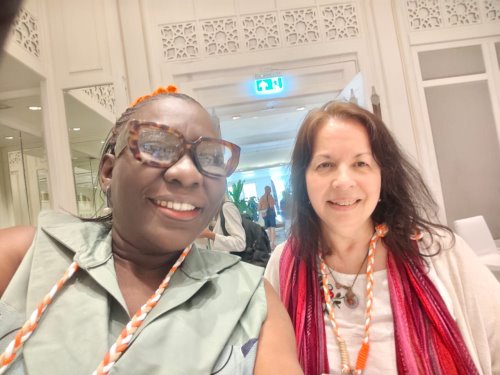
The two most active Mundus maris representatives
Overall, the congress served as a catalyst for expanding the association’s professional network. Several participants were met, and numerous strategic contacts established during the technical and social sessions. These interactions drew considerable interest to Mundus maris as an association, with several individuals expressing a strong desire to join or lead new initiatives, such as the establishment of SSF Academies in other regions. We are happy to have contributed constructively to this important gathering, advancing understanding and action lines on blue solidarity and blue justice.
The participation in the 5th WSFC resulted in academic validation, enhanced regional integration, and the shortlisting of a major funding proposal. The immediate focus following this report will be the finalisation of the full Global Fisheries Research Program proposal and the formal onboarding of the various contacts interested in the mission of the Mundus maris.
A big thank you to the TBTI network for having created such a wonderful, productive working environment. Now we are looking forward to the next operational steps of the discussed initiatives.
Accademia della Pesca Artigianale
- The SSF Academy convenes the second workshop in Ghana
- Mundus maris presents the SSF Academy in Ghana at the 3rd SSF Summit in Rome
- Restoring Ghana’s fisheries starts with the people who depend on them
- Small-Scale fisheries should be a big part of the future in West Africa
- Plunder in the Atlantic: When Overfishing Threatens the Sea and Coastal Communities
- Our Power, Our Planet – Celebrating Earth Day Webinar
- Mundus maris all’EGU26, 3-8 maggio 2026
- Mundus maris at the aspirational 5th World SSF Summit, Thailand
- Trasformare un’erbaccia acquatica in una fonte di reddito
- Pescatori artigianali e ambientalisti ripensano insieme la pesca
- Make Fishing Fair
- La pesca eccessiva straniera alimenta la mortale crisi migratoria del Senegal verso l’Europa
- Mundus maris at MARE 2025
- I pescatori artigianali al centro della governance dell’oceano e della sicurezza alimentare
- Make Fishing Fair in the EU, 25 March 2025
- Human – Biodiversity Relationships Across Scales
- World Fisheries Day, 21 November 2024, celebrated in Nigeria
- Mundus maris partecipa al 2024 World Fisheries Day organizzato dalla Canoe and Fishing Gear Association del Ghana (CaFGOAG).
- Mundus maris contribution to the UNOC3 public consultation
- Vertice sulla pesca artigianale a Roma, 5-7 luglio 2024
- Regional Symposium on European Small-Scale Fisheries, Larnaca, Cyprus, 1-3 July 2024
- Riunione di emergenza sulla pesca nel Baltico, Bruxelles, 26 giugno 2024
- Ambivalent role of Market and Technology in the Transitions from Vulnerability to Viability: Nexus in Senegal SSF
- Shell fisheries as stewardship for mangroves
- Giornata mondiale della pesca, 21 novembre 2023
- Webinar: Nigeria’s Fisheries challenges and opportunities
- Presentazione della FishBase app al Symposium di Tervuren
- Convegno MARE sulla paura blu – Mundus maris riflette
- The Transition From Vulnerability to Viability Through Illuminating Hidden Harvests, 26 May 2023
- Sessioni EGU focalizzate su geoetica e apprendimento congiunto
- Solidarietà con i pescatori artigianali in Senegal e Mauritania
- The legal instruments for the development of sustainable small-scale fisheries governance in Nigeria, 31 March 2023
- Tools for Gender Analysis: Understanding Vulnerability and Empowerment, 17 February 2023
- Community resilience: A framework for non-traditional field research, 27 January 2023
- Sustainability at scale – V2V November webinar
- Edizione africana del 4WSFC a Cape Town, 21-23/11/22
- Edizione Europea del 4WSFC in Malta, 12-14 Settembre 2022
- Mundus maris contribuisce all’SSF Summit in Roma
- Donne commercianti di pesce a Yoff e Hann in Senegal, vittime o artefici del loro destino?
- L’Accademia continua il suo lavoro a Yoff
- Illuminating the Hidden Harvest – a snapshot
- Virtual launch event FAO: International Year of Artisanal Fisheries and Aquaculture
- The Small-Scale Fisheries Academy as a source of operational support to PA Guidelines
- Congresso mondiale della pesca, Adelaide, 20-24 settembre
- Mundus maris sostiene la lotta di Paolo il pescatore, in Toscana, Italia
- Catching-up – SSF Academy Yoff, 27 Febr. 2021
- Rafforzare le capacità degli attori per una pesca sostenibile su piccola scala
- Sperimentazione dei metodi di formazione durante la fase pilota dell’Accademia SSF in Senegal
- Una prima assoluta: il lancio di un’Accademia della Pesca su Piccola Scala in Senegal