 From 28 September to 2 October 2026, the Small-Scale Fisheries Academy in Ghana convened its second workshop for community dialogue meetings in support of co-management. This time, the Academy practitioners met in Elmina, Central Region, as a result of the partnership between Mundus maris and the Canoe and Fishing Gear Owners Association of Ghana (CaFGOAG).
Eight national trainers (two from each coastal region), 20 regional trainers (five for each region, including one officer of the Fisheries Commission), and a policy director from the ministry together with the Mundus maris team and the CaFGOAG coordinator drew lessons from the experiences with first two or three community dialogues in eight pilot villages. Two researchers, one from the University of Bern, Switzerland, the other one from the University of Cape Coast participated in the first two days of the workshop.
The first group discussions were among facilitators across different regions to support peer learning. The starting question was: What has changed in the communities in the last two to five years.
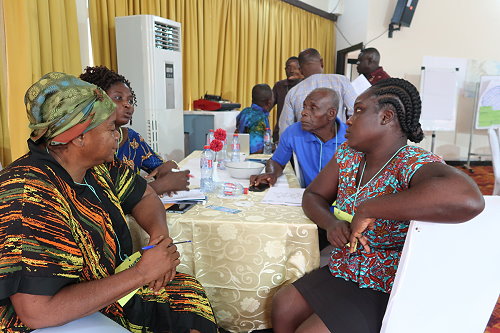
Intensive discussions in small groups with participants from several regions to encourage peer learning
Among the observations that were common, shrinking resources, substantial catches of juveniles, increasing illegalities, weak enforcement of rules, and loss of price fixing capacity of the Queen Fishmonger, the Konkohemaa as the most powerful woman in the community, stood out.
The next question was ‘what do you know about the new Fisheries and Aquaculture Act’? The conversations were quite animated as participants highlighted particularly those aspects, often in considerable detail, that concerned their profession directly. Among the points raised were the extension of the exclusion zone from 6 to 12 nautical miles, increase in licensing requirements for all professions, prohibition of catching juveniles, increased penalties for illegal fishing or other ways of breaking the law, the setting up of central co-management committees to cover scientific, managerial and traditional knowledge matters, and a special fisheries and aquaculture development fund.
The next questions were: ‘What are the differences between the Act and the Draft Regulations intended to operationalise the Act?’ and ‘What are the rights and responsibilities of the different groups of actors, from canoe owners, chief fishermen, to fish processors and traders, to boatswains and crews?’ These questions gave rise to more intense exchange and assessments within the cross-regional groups.
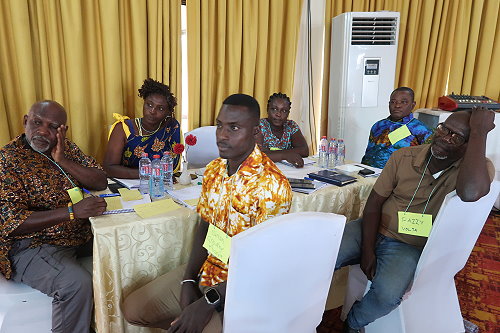
Group listening attentively to the next question
The next question was for groups of practitioners from the same region: ‘What are regulations practised now, either on the basis of traditional practices or on the basis of previous national regulations?’
In the Volta Region e.g. one of the rules was to have a fishing holiday on Sundays. Sea turtle catching was taboo because they are a totem. Likewise dolphins are not to be caught and met out punishment for breaches of the rules. Every year, a festival would provide an occasion to celebrate the past season and make sacrifices to the sea god to pray for the next bumper harvest.
Groups also noted that the weather forecast had been improved and contributed to fewer accidents at sea.
The women reported that a training programme was offered how to wash hands and handle fish in the most hygienic conditions, notably, not putting catches of marine small pelagics onto the sand, which had often been done to drain the water faster before drying and smoking.
Dynamite and light fishing had been prohibited already, but was not easy to enforce.
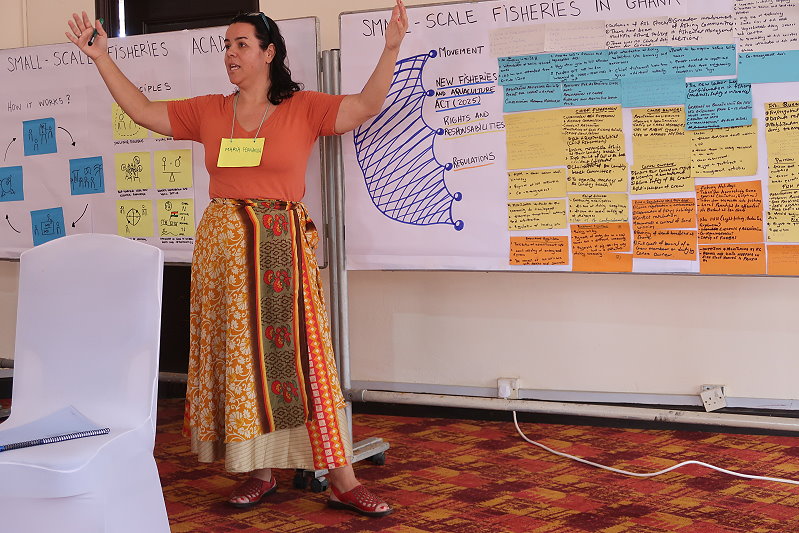
Compiling all the answers to the questions debated in the groups
The key idea carried over into the second day was that policy does not always come only from central government. Co-management as envisaged in the Act encourages to develop locally adapted rules and also to report local issues up through regional to national levels as well as taking note of what comes from national level, deliberated e.g. in the Small-Pelagics Scientific Co-Management Committee which should take off some of the pressures on the chief fisherman and the Landing Beach Enforcement Committee.
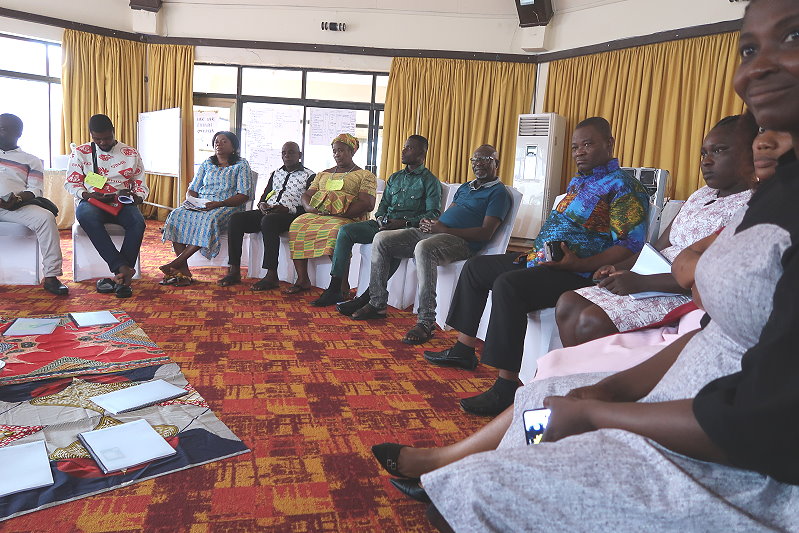
The morning circle on Day 2 recapping results of Day 1 and setting the tone for the day’s work
Group work by region then focused on what had worked well in the community dialogues, what had not worked very well so far, and what facilitators wanted to do differently in the next meetings. Starting out with individual reflections, the next step was to compare notes and distill guidance for productive and action-oriented meetings.
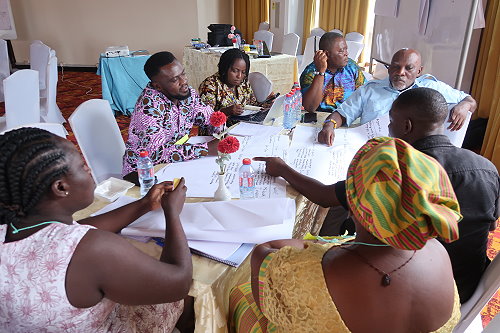
Central Region group discussion
Among the lessons learnt were:
- timing of dialogue meetings should be suitable to key members of each professional group
- the invitation must be friendly and explain the purpose with focus on generating action
- per diems will not be paid, but refreshments should be served
- make sure that key members are present and each one speaks
- use visualisation means to ensure all ideas are captured
- document results and share to support getting better step-by-step.
The day concluded with a recap of what mattered for a well-planned meeting and its documentation for sharing experiences with the entire group. The reporting should start with the identification of the village, region, lead facilitator, day, time, venue, agenda and include key results. Ideally, reporting should also be backed up with photos and videos to make the exchanges as lively and instructive as possible.
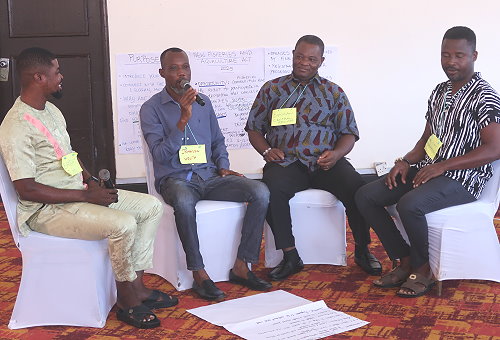
Frantic radio spot explaining IUU fishing and interviewing a fisher who was using dynamite to get easy catches
Day 3 started with in-depth work on constructing the agenda for a dialogue meeting in the fictitious village of Keeta and how to share roles with community meetings to ensure active involvement. Academy practitioners were invited to take note in the notebooks they had received on Day 1 and use the design pages around pictograms of the 10-step approach to a productive gathering.
The highlight of the day was in the afternoon, when six randomly mixed groups were formed and each selected a method on how to practice variations to the meeting introduction.
The methods to address co-management and its challenges and opportunities addressed the more ‘ordinary’ as well as the undesirable issues in communities that were nevertheless part of the lived realities that needed to be tabled in suitable ways.
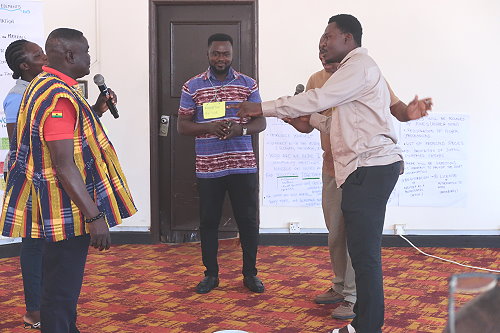
Accused of landing juveniles and selling them off even though the slogan of the women in NAFPTA is ‘NAFPTA, say no to bad fish!’
The suggested ways in which these topics were to be introduced were:
- role play
- radio transmission
- theatre
- drama
- proverbs and stories
- create a song
The time given to come up with a performance was quite short, but enough to reveal considerable talent in mastering the different forms of expression and engaging the rest of the group sitting in the circle observing and enjoying immensely as the energy of each group was contagious to the others.
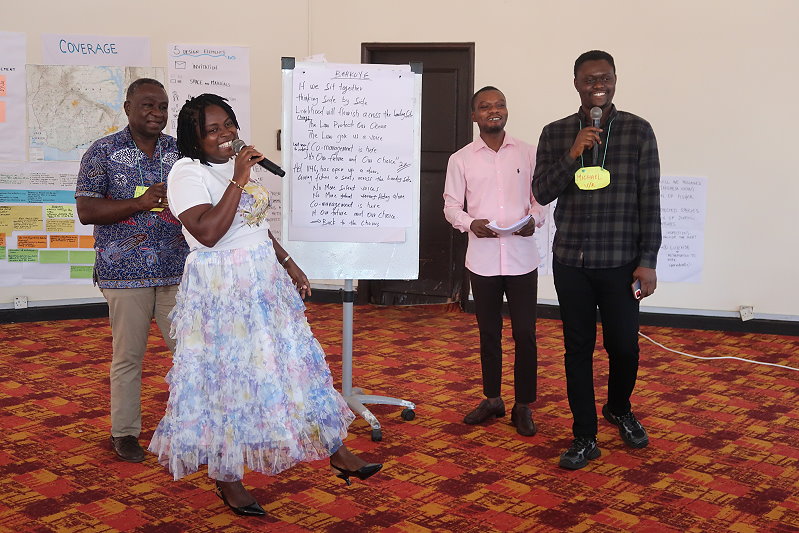
The group tasked with creating a song did so well that the text was voted to become the anthem of the Academy! Congrats!
Day 4 in the presence of the Regional Director of the Fisheries Commission, Mr. Dovlo, was centered on reviewing and adjusting the one-year plan for each community. What is the vision which motivates action? A vision for one year can be the beach is clean with plenty coconut tries. A vision for a longer period is a bumper harvest from a healthy resource; all kids go to school, basic health services are available in the village. This inspires continued efforts, but can not achieved within one year.
The facilitators then discussed how to expand from 8 to 20 pilot communities in the four coastal regions in line with existing capacities. Several ways were evaluated to make sure that the time of the present facilitators is used more effectively thanks to better planning. Sharing responsibilities and activities judiciously between regional and facilitators is a good approach such that the workload does not become excessive for anyone. They agreed to regular monthly meetings and the next Academy session in January 2027. There was also agreement of the need to increase the number of women both in the teams and as actors in the community dialogues
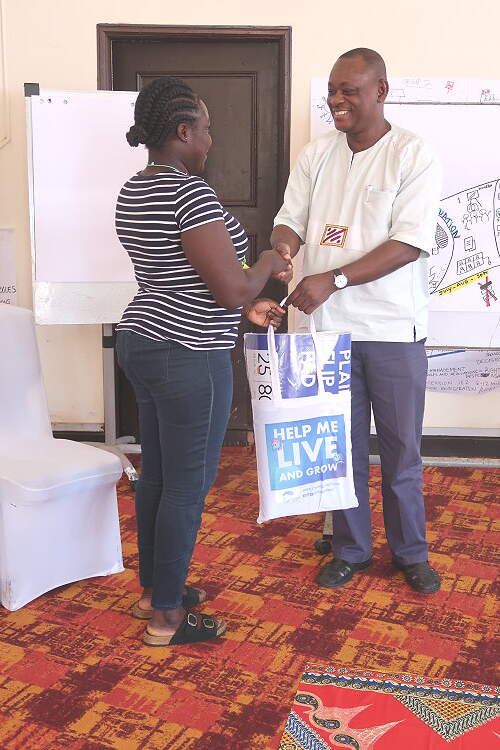
Mr. Dovlo, Regional Director of the Fisheries Commission handed over the facilitation kit, here to regional facilitator Mary Amoaful from Central Region
At the closure, Mr. Dovlo acknowledged the good work done so far and promised that not only would he support the Academy work in the Central Region, but would also talk to fellow directors in other coastal regions to do likewise.
In her closing remarks, Cornelia E Nauen of Mundus maris thanked all participants for their strong commitment and particularly Maria Fernanda Arraes Treffner as chief facilitator for bringing the Academy spirit to life. She expressed the confidence that the community dialogues would continue to build stronger co-management capacities and looked forward to implementing the agreed activity plan supporting this. She also signaled the wish, agreed with CaFGOAG, to bring the National Fish Processors and Traders Association (NAFPTA) also officially into the partnership.
Kenneth Arthur of CaFGOAG expressed his satisfaction with the workshop and the confidence that the good work of the facilitators was paving the way towards co-management in practice. He appealed to make good use of the facilitation materials provided and to step up regular reporting to enable systematic peer learning.
The Regional Director then handed the Mundus maris bags with the basic materials to each one of the regional facilitators, namely flip chart pads, markers, masking tape and the policy brief about the first Academy workshop disseminated at the SSF Summit at FAO HQ in early September.
With that and the final group photo the regional facilitators were released and could return, while the national facilitators and coordinators remained together for a final evaluation and agreeing on the next development steps.
All efforts now are to steady the community dialogues and expand systematically into the agreed additional communities, step-by-step, as well as enrolling more women and additional partners. The SSF Academy in Ghana is on the road!
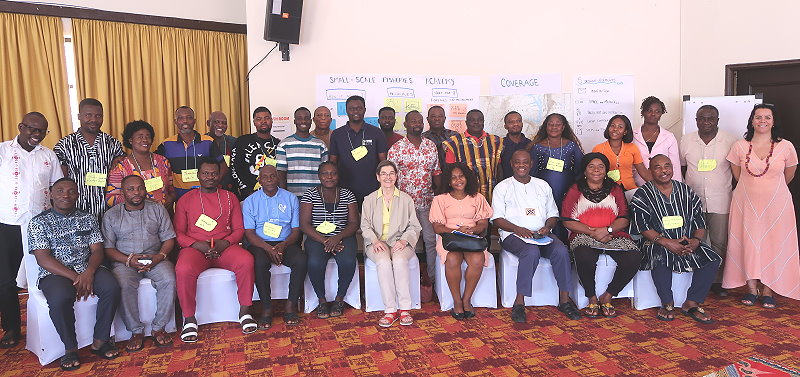
Group photo of practitioners of the second SSF Academy workshop in Elmina, Ghana
Académie de la pêche artisanale
- The SSF Academy convenes the second workshop in Ghana
- Mundus maris présente l’Académie PAD au Ghana lors du 3e Sommet PAD à Rome
- La revitalisation du secteur de la pêche au Ghana repose sur les personnes qui en dépendent
- La pêche artisanale devrait jouer un rôle majeur dans l’avenir de l’Afrique de l’Ouest
- Le pillage de l’Atlantique : quand la surpêche menace la mer et les communautés côtières
- Notre Pouvoir, notre Planète – Un Webinaire pour célébrer le Jour de la Terre
- Mundus maris lors de l’EGU26 à Vienne, du 3 au 8 mai 2026
- Mundus maris at the aspirational 5th World SSF Summit, Thailand
- Turning a water pest into a source of income
- La pêche artisanale PAD et les défenseurs de l’environnement repensent ensemble la pêche
- Rendre la pêche équitable
- La surpêche étrangère alimente la crise migratoire meurtrière du Sénégal vers l’Europe
- Mundus maris at MARE 2025
- Les pêcheurs artisanaux au cœur de la gouvernance de l’océan et de la sécurité alimentaire
- Rendre la pêche équitable dans l’UE : 25 mars 2025
- Relations entre l’Homme et la biodiversité au travers de différentes échelles
- Célébration de la Journée mondiale de la pêche au Nigeria, 21 novembre 2024
- Mundus maris a participé à la Journée mondiale de la pêche 2024 organisée par la Canoe and Fishing Gear Association of Ghana (CaFGOAG).
- Contribution de Mundus maris à la consultation publique de l’UNOC3
- Sommet sur la pêche artisanale à Rome, 5-7 juillet 2024
- Symposium régional sur la pêche artisanale européenne, Larnaca, Chypre, 1-3 juillet 2024
- Réunion d’urgence sur la pêche dans la Baltique, Bruxelles, 26 juin 2024
- Ambivalent role of Market and Technology in the Transitions from Vulnerability to Viability: Nexus in Senegal SSF
- Shell fisheries as stewardship for mangroves
- Journée mondiale de la pêche, 21 novembre 2023
- Séminaire en ligne : Défis et opportunités de la pêche au Nigeria
- Présentation de l’application FishBase au Symposium de Tervuren
- Conférence MARE sur la Peur bleue – Mundus maris réfléchit
- The Transition From Vulnerability to Viability Through Illuminating Hidden Harvests, 26 May 2023
- Les sessions de l’EGU se concentrent sur la géoéthique et l’apprentissage collaboratif
- Solidarité avec les artisans pêcheurs du Sénégal et de la Mauritanie
- The legal instruments for the development of sustainable small-scale fisheries governance in Nigeria, 31 March 2023
- Tools for Gender Analysis: Understanding Vulnerability and Empowerment, 17 February 2023
- Community resilience: A framework for non-traditional field research, 27 January 2023
- Sustainability at scale – V2V November webinar
- Edition Africaine du 4ème Congrès Mondial de la Pêche Artisanale (4WSFC) à Cape Town, du 21 au 23 novembre 2022
- 4WSFC Europe à Malte, 12-14 septembre 2022
- Mundus maris prend part au Sommet de Rome consacré à la pêche artisanale
- Women fish traders in Yoff and Hann, Senegal, victims or shapers of their destiny?
- L’Académie continue son travail à Yoff
- Illuminating the Hidden Harvest – a snapshot
- Virtual launch event FAO: International Year of Artisanal Fisheries and Aquaculture
- The Small-Scale Fisheries Academy as a source of operational support to PA Guidelines
- World Fisheries Congress, Adelaide, 20-24 September
- Mundus maris supports the fight of Paolo, the fisher, in Tuscany, Italy
- Rattrapage – Academy PAD à Yoff, 27 févr. 2021
- Renforcement des capacités des acteurs de la pêche artisanale
- Essai des méthodes de formation lors de la phase pilote de l’Académie PAD au Sénégal
- Une première – Inauguration d’une Académie de la pêche artisanale au Sénégal