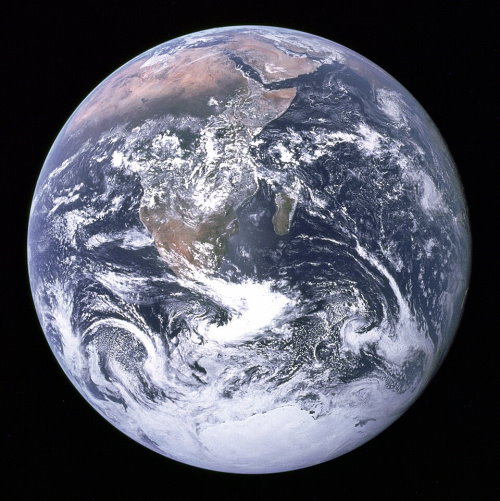
The Blue Marble, taken by Harrison Schmitt of the Apollo 17 crew in 1972. The original photograph was taken with the South Pole facing the top; however, this version is the most widely distributed.
We might think that here in Hilden—and throughout North Rhine-Westphalia—we are « landlubbers » and the ocean is a few hours’ drive away. Yet we are connected to the sea in many different ways; it shares the same salinity as our blood. It stabilizes the climate—which would otherwise be thrown even further out of balance—produces a large portion of the air we breathe, and much more. More than 90% of global trade—amounting to 1.5 tonnes per person alive today—is conducted via the ocean each year. It was in this context that Timmi, the humpback whale whose plight captivated so many, appears to have been injured by a ship’s propeller.
For centuries, wild-caught seafood provided us with a reliable source of healthy, wholesome nutrition. However, particularly as industrial fishing ramped up after World War II, the « peace dividend » of abundant fish stocks was exhausted as early as the 1960s. Even in the 1970s and 80s, up to 10 million tonnes of food fish were landed from European waters; yet, the capacity of industrial fleets was already outstripping the rate of natural replenishment. Since then, landings from local stocks have declined, hitting a low of just over 3 million tonnes. It is as if we had declared war on fish and other marine life—and we are « winning » it! Consequently, there is increased fishing in foreign waters and a rise in imports to meet high demand. Yet, this means overfishing has become the new reality across all ocean basins. The notion of an inexhaustible ocean is a mirage—long since recognized as a mere hallucination (and not just by AI).
We are placing additional strain on the ocean through greenhouse gas emissions—which drive rapidly rising sea temperatures—as well as diverse sources of pollution, including fertilizers from industrial agriculture, pharmaceutical residues, industrial wastewater, and—by now—staggering amounts of plastic waste. Billions of toxic plastic cigarette filters not only poison the soil and groundwater in their immediate vicinity but also make their way into the sea via rainwater, sewage systems, streams, and rivers. Some researchers have already compared the hype surrounding the « Blue Economy »—with its absurd investment and profit projections—to the subprime financial collapse of 2008–2010. The only difference is that, unlike paper money, you cannot print tuna.
Unlike some other places, the clean-up to kicking off World Ocean Day celebrations in Hilden, Germany, called by Mundus maris, attracted primarily several senior citizens. Starting with expressing their interest during the volunteering action day in May and some feedback in response to the Facebook event announcement, the invitation to clean up the surroundings of one of the creeks in town seemed to speak primarily to senior citizens. Even those who could not make it in the end said that they cared deeply about the public good and wanted to contribute to ocean health, even at modest local level.
So, in the early afternoon volunteers gathered at the agreed meeting point and got the gloves kindly made available by an association specialised in clean ups in town, and pincers and a special collection bag for each one from the city’s garbage management unit. They formed groups of three to swarm out in different directions to clean up the vicinity of the creek in order to avoid cigarette butts, household plastic, and other garbage from being transported through the sewers or the creek into the Rhine River and eventually into the North Sea and the global ocean.
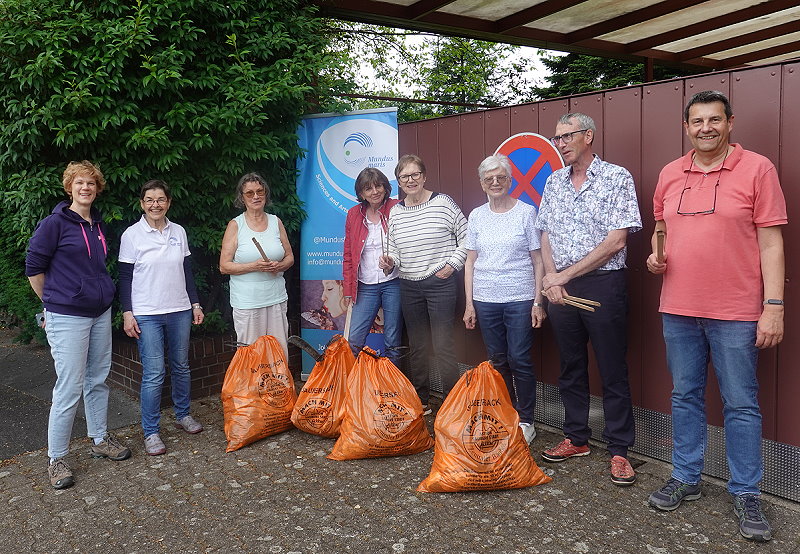
At the end of less than two hours collection, 21 kg of garbage had been collected, which were afterwards discharged at the municipal garbage management unit for safe processing. Numerically cigarette butts were by far the most frequently collected item, despite repeated newspaper articles and civil society organisations, including Mundus maris. A distant second were food and sweets wrappings. A few glass bottles were also collected and discharged separately in special glass containers.
The brave volunteers came back satisfied and happy for their engagement for the ocean and their immediate surroundings reflecting on the UN motto for this year’s World Ocean Day « Reimagine. Beyond The World We Know, A New Relationship With The Ocean. They closed their day with good chats and lots of laughter around a cup of coffee and home-made cakes. What a great way to have togetherness and agency on top of saving tax payers money rather than spending it.