At the scientiFRIKA 2026 Delegate Retreat and Workshop, held from June 2 to June 4, 2026, at the Lagos Oriental Hotel in Victoria Island, Lagos, Nigeria, Dr. Ayojesutomi Abiodun-Solanke delivered an insightful presentation that highlighted the critical intersection of local agricultural practices and global trade requirements. Speaking as the General Secretary of the Nigerian Women in Agricultural Research for Development, Dr. Abiodun-Solanke addressed the first day’s thematic session on Global Food Safety Standards and Compliance. Her presentation focused on the vital necessity of transitioning African small-scale fisheries from compliance by accident to compliance by design, particularly by overcoming the carcinogenic chemical barriers associated with traditional wood-fired fish smoking methods. Dr. Solanke also coordinates Mundus maris activities in Nigeria.
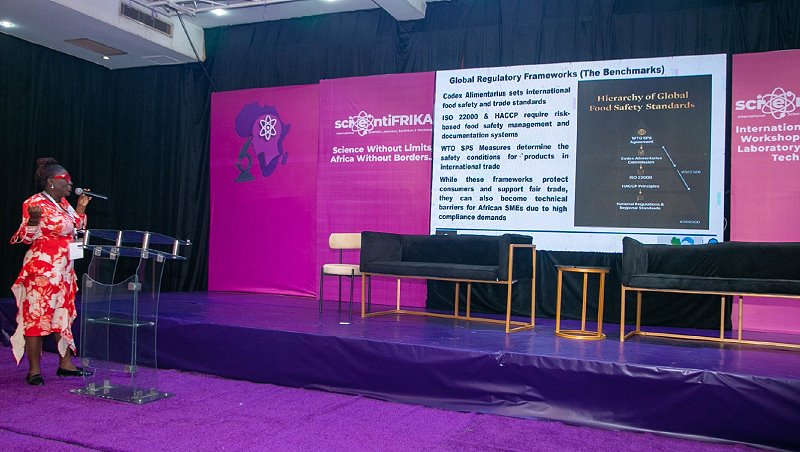
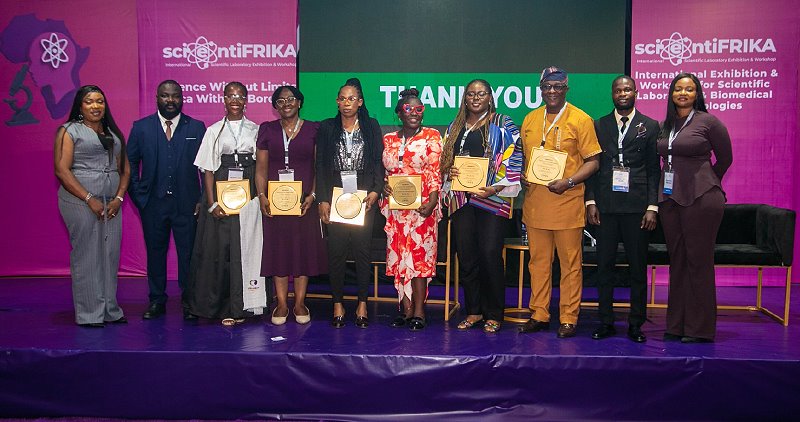
Dr. Ayojesutomi Abiodun-Solanke presenting
Following her individual presentation, Dr. Abiodun-Solanke participated in a panel session titled ‘Bridging the Gap: National and Regional Regulations and Global Food Safety Standards’. This panel served as a timely forum to emphasize how robust global and regional partnerships are required to successfully harmonize local food production with international safety frameworks.
The seafood we eat is a critical issue that transcends public health, serving as a cornerstone of trade, poverty alleviation, gender equity, and economic security across Africa. However, a profound disconnect persists between informal local market practices, which rely heavily on traditional knowledge, and the stringent, high-tech traceability and zero-chemical-residue benchmarks demanded by international bodies such as the European Union and the Codex Alimentarius Commission. To transform the African seafood trade from a state of compliance by accident to compliance by design, the sector must confront entrenched traditional bottlenecks while embracing gender-responsive engineering and biochemical innovations.
In Nigeria and across West Africa, traditional wood-fired smoking methods remain the cultural and economic baseline for preserving fish. This processing method presents a severe safety paradox because traditional wood combustion introduces carcinogenic Polycyclic Aromatic Hydrocarbons, commonly known as PAHs. While consumers often prefer the taste and color imparted by these traditional methods, the resulting chemical residues frequently exceed international safety limits, such as the strict four parts per ppb standard, creating a massive non-tariff barrier to global market entry.
To eliminate this bottleneck, Project ID 157 under the Gendered STEAM initiative introduced an innovative technological solution known as the Irorunde Kiln. Developed with an emphasis on sustainable biomass energy, this insulated drum oven features food-grade stainless steel components, integrated smoke filtration to minimize PAH contamination, and precise temperature and smoke control mechanisms. Its portable and ergonomic design specifically accommodates the physical workflows of women processors, who handle over eighty percent of fish processing in Nigeria. By deploying affordable local technologies like the Irorunde Kiln, rural operators are empowered to elevate their output to export-grade quality, successfully satisfying strict international biochemical thresholds.
Beyond structural smoking advancements, recent doctoral research investigated mitigating post-harvest spoilage by replacing synthetic chemicals with organic, plant-based antimicrobials. This research evaluated the shelf-life extension and microbial suppression capabilities of various natural extracts against a control group processed without any preservatives. The experimental treatments yielded a clear hierarchy of efficacy, revealing that orange peel, scientifically known as Citrus sinensis, performs the best at extending stability, followed by ginger, then garlic, with the unpreserved control group performing the worst. Utilizing citrus peels leverages a common agricultural byproduct to offer an accessible, zero-residue preservation method. This allows small-scale fish processors to extend product shelf-life and meet international logistics timelines without violating chemical residue restrictions. The slides of the talk are available here.
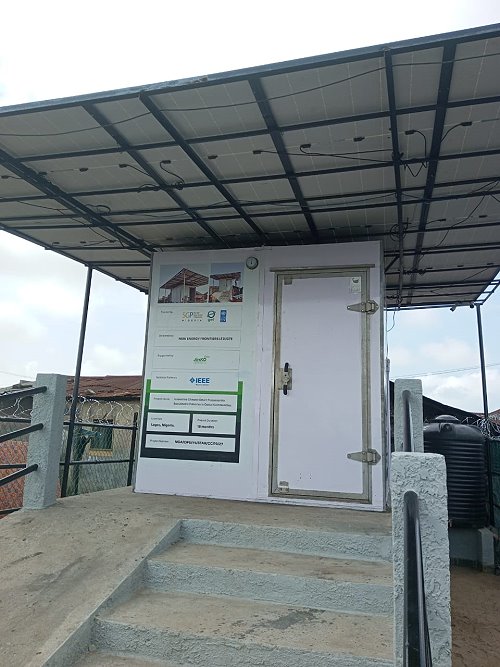
Solar-powered cold room intended as a fish preservation solution in the island community of Sagbokoji in Lagos State in 2024
While technological and biochemical innovations offer clear benefits, their long-term success depends heavily on the social frameworks governing their deployment. The implementation of a decentralized, solar-powered cold room solution in the island community of Sagbokoji in Lagos State serves as a vital case study in project management and community relations. This infrastructure was designed to maintain a reliable cold chain, curb post-harvest losses, and ensure regulatory temperature compliance. However, the cold room stands abandoned today, yielding no meaningful productive output despite attempts at co-management.
An analysis of this project failure reveals that the cold room was abandoned due to a complete lack of co-creation with the local community. The project team conceptualized, drafted, and secured funding for the grant proposal before establishing contact with the residents of Sagbokoji. The community was contacted and identified only after the proposal had been written and won, treating the local actors as passive recipients rather than active partners. Introducing a co-management framework after deployment cannot fix a fundamental lack of community ownership. Because the technology was introduced without integrating local socio-economic realities, daily routines, or early stakeholder feedback, the community did not adopt it.
Moving forward, bridging the gap between traditional West African fishing practices and international compliance standards requires a shift in strategy. Future infrastructure grants must mandate upstream co-creation, requiring proof of genuine community engagement and participatory design before any proposal is submitted or funded. Because women are the primary stakeholders in the processing sector, initiatives should prioritize funding for ergonomic, low-PAH systems like the Irorunde Kiln while commercializing orange-peel-based natural preservatives to replace hazardous chemical options. Finally, working through professional networks like the African Association for Food Protection can help harmonize national food safety laws with regional trade directives, reducing compliance costs and securing a sustainable future for the seafood we eat.
A key takeaway from the discussion was that successful technical interventions cannot be achieved through a top-down approach; rather, they require early-stage, authentic co-creation with the target communities to prevent infrastructure abandonment and ensure long-term, sustainable market access.
This is a lesson all participants of the ScientiFRIKA 2026 take home to their labs and other work places. Co-creation with user communities offers great opportunities for impactful and sustainable innovation.
Il mare ci nutre
- ScientiFRIKA 2026 provides insights in the safety of artisanal fish food production
- Win Big – Baltic Event
- World Food Day 2024, Joint Webinar with Fish Party
- Relatore Speciale delle Nazioni Unite sul diritto al cibo
- EP Hearing on EU Citizen Initiative to stop shark finning
- Keynote at the ‘Feed the Future – Innovation Lab for Fish’
- FAO webinar ‘Pesce piccolo a basso prezzo: dall’esca al piatto’, 15-16/02/2021
- Pesce e frutti di mare deliziosi e sostenibili ai workshop di Mundus maris
- Chiloé, ossia: il disastro di Salmonopoli
- Seafood Symposium – Dalla pesca ai buongustai, 27 Aprile 2015
- Baltic students concerned about sustainable foods, Rogow, Poland, 15-19 April 2015
- Dai piatti al carburante – il controverso boom delle alghe in Cile
- Khazan – Traditional coastal zone management in Goa, India
- Comportamento del consumatori attento all’ambiente nel settore alimentare: cosa posso fare?
- Save baby fish or Point ‘n’ kill?
- “Inseparable” – La campagna sulla sostenibilità del pesce celebra un evento ad Atene
- Respect for minimum fish size. What do Senegalese fish mongers have to say?
- La campagna di Mundus maris nei mercati di Dakar
- Salviamo gli Oceani! – Cercle Europa esorta
- International Study Group Brussels: Save the Seas!
- Mercado San Miguel in Central Madrid