Review of the Deutsche Welle documentary by students Damián Mosteiro, Mercedes Cibalerio, Abril Espinosa, Keylmary Ojeda, Barbara Morales, Victoria Villalba Diaz, María Poggi Villalobos, Agustina Kustner, Lucas Cordero, Natalia Bustingorry, Lucas Palacio, Bautista Palacio Fernández, Dolce Wolcoff, and Lucía Hermida. Adapted and edited by Dr. Marcelo L. Morales Yokobori, Marine Resources Chair. Biology undergraduate program. Universidad de Belgrano, Buenos Aires.
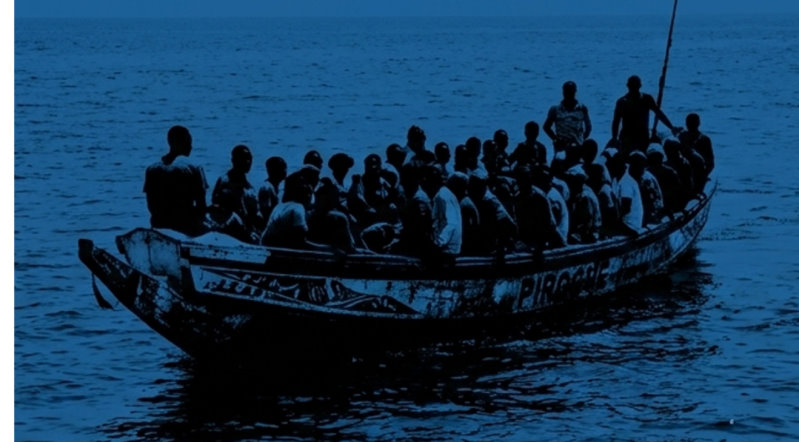
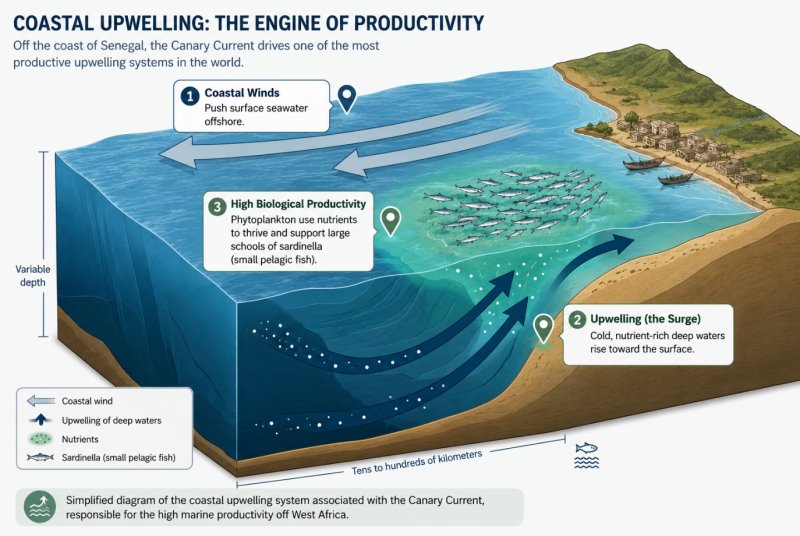
Deutsche Welle documentary’s “Plunder in the Atlantic: Overfishing and Exploitation of the Sea” tackles the fishing crisis in Senegal’s exclusive economic zone (EEZ), where the advance of foreign industrial fleets and the expansion of fish meal factories are drastically reducing stocks of small pelagic fish. The region is of strategic importance for the world’s marine resources due to the influence of the Canary Current, one of the four most productive upwelling systems on the planet, whose biodiversity sustains food security and the employment of millions of people (Pauly et al., 2025).
Through testimonies from artisanal fishermen, fish processors and specialists, the documentary shows how the decline of marine resources affects not only the ecosystem, but also the economic and social stability of coastal communities. In this way, it allows us to analyse the close relationship between overfishing, environmental degradation, economic inequalities and the social consequences derived from the intensive exploitation of the sea.
From an ecological perspective, the problem reflects processes of loss of ecosystem resilience, decrease in biomass and alteration of marine food webs. On the economic level, it exposes the tensions between global markets and local food security. Finally, from a social point of view, the documentary shows how the fishing crisis contributes to the increase in poverty and favours migratory processes towards Europe.
Ecological and environmental impacts
One of the main problems addressed by the documentary is the overexploitation of marine resources in Senegal. For decades, West African waters were considered one of the most productive fishing areas on the planet due to the high availability of nutrients generated by upwelling phenomena associated with the Canary Current (Pauly et al., 2025). This high productivity allowed the historical development of important artisanal fisheries based mainly on small pelagic fish.
However, the progressive entry of foreign industrial fleets significantly increased the extractive pressure on marine stocks. As a result, typical signs of overfishing began to be observed, including a decrease in biomass and a reduction in catch per unit effort (CPUE). The testimonies presented in the documentary reflect how artisanal fishermen must travel greater distances and stay longer at sea to obtain smaller and smaller catches.
The fall in the CPUE is one of the most widely used indicators to assess the exploitation status of a fishery, as it reflects a decrease in fish abundance. When fishing effort increases while catches decrease, it is evident that the rate of extraction exceeds the annual regrowth of the exploited stocks. Hilborn and Ovando (2014) argue that fisheries can only be maintained sustainable through effective management and control systems; In the absence of these mechanisms, overexploitation becomes highly likely.
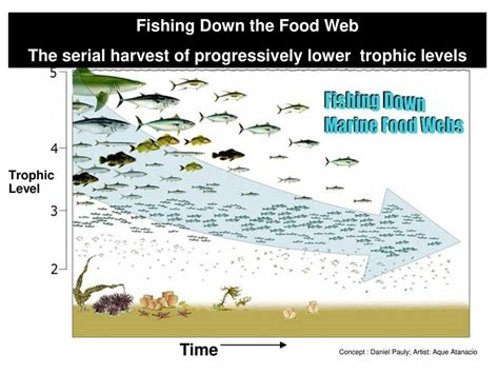 Another relevant impact is the alteration of marine food webs. Intensive harvesting of small pelagic fish affects numerous organisms that depend on them as a food source, including larger fish, seabirds and marine mammals. Pauly et al. (1998) described this phenomenon as fishing down marine food webs, whereby fishing pressure progressively modifies the structure of marine food webs.
The documentary also highlights the impact of industrial trawling. These vessels have an extractive capacity much higher than that of artisanal fishing and generate high levels of bycatch, part of which is discarded, often without the possibility of survival. Gilman et al. (2020) estimate that millions of tonnes of marine fauna are discarded annually in global fisheries, constituting one of the main challenges for marine sustainability.
The expansion of fish meal and fish oil factories (see image below) also generates significant ecological and food impacts. These industries use small pelagic fish that were historically intended for human consumption to produce animal feed aimed mainly at European and Asian markets. Dème et al. (2023) point out that this dynamic produces strong tensions between exports and local food security, as species that are fundamental to the regional diet are diverted into global animal production chains.

Inside a fish meal factory (photo courtesy Paul Abell on Pexel)
Faced with this scenario, fisheries management acquires a central role. Marine protected areas can contribute to the recovery of exploited populations and the conservation of reproductive areas, although their effectiveness depends on the existence of real controls, adequate financing, and community participation (Ferraro et al., 2011). Likewise, scientific monitoring, regulation of fishing effort and the implementation of catch limits are essential tools to guarantee the sustainability of marine ecosystems.
Economic tensions and global markets
For decades, Senegal was synonymous with fishing. Its coasts not only fed millions of people, but also sustained an extensive economic network made up of artisanal fishermen, traders, shipwrights, transporters and fish processing workers. However, the overexploitation of marine resources profoundly altered this productive dynamic.
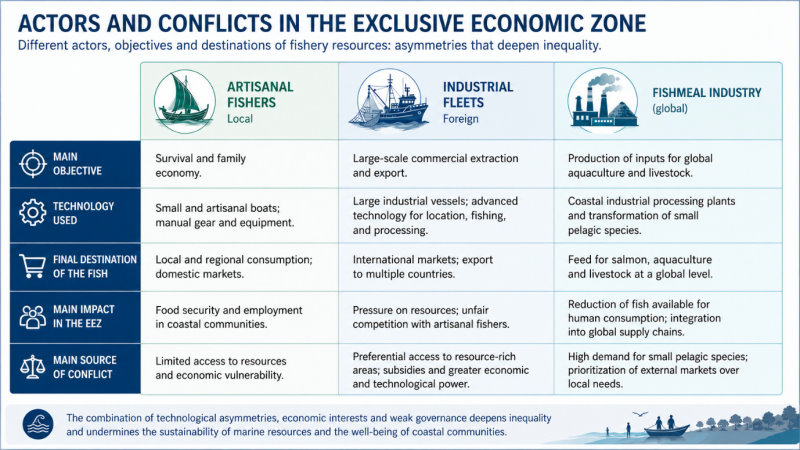
The Senegalese fishing crisis cannot be explained solely by the decline in fish, but by the interaction between overfishing, foreign industrial fishing, illegal fishing, institutional weakness and global economic dynamics that prioritize exports over local supply. The documentary shows how large foreign industrial fleets access marine resources through international agreements that often operate in contexts of little oversight and limited state control capacity.
One of the most relevant economic indicators is once again the fall in catch per unit effort (CPUE). Artisanal fishermen must invest more time, fuel and resources to obtain smaller and smaller catches, increasing operating costs and reducing the profitability of the activity. As a consequence, many coastal communities face processes of indebtedness and growing economic precariousness.
The expansion of fish meal and fish oil factories is another of the central conflicts. These industries purchase large quantities of small pelagic fish to be processed into food mainly for international animal production. Dème et al. (2023) warn that in Senegal, Mauritania and The Gambia an increasing proportion of these resources is absorbed by this industry, reducing the availability of protein and nutritious food accessible to local populations.
This dynamic reflects a strong economic distortion: species that are fundamental to regional food security are incorporated into global production chains aimed at markets with greater purchasing power. It even generates an economic paradox, since the State subsidizes fuel to sustain fishing activity, while part of those resources ends up supplying foreign export industries.
Another problem identified is the so-called “Senegalization” of foreign vessels. Through local intermediaries, foreign-owned vessels operate under the Senegalese flag and have access to national fishery resources. Kadfak and Antonova (2021) argue that regulations against illegal fishing are only effective when States have real capacity for implementation, control, and control.
In this context, fisheries governance appears as a central element. The documentary shows how existing international agreements and regulations are often insufficient in the face of the economic and technological power of industrial fleets. This shows the need to strengthen state institutions, oversight mechanisms, and management systems based on scientific evidence.
Social consequences and migration
The documentary deals in depth with the social consequences derived from the fishing crisis in Senegal. Artisanal fishing has historically been a central activity for coastal communities, not only as a source of food, but also as an economic, cultural and identity axis.
One of the main conflicts identified is the technological inequality between industrial fleets and local artisanal vessels, known as pirogues. While large vessels have modern location, cooling and processing systems, artisanal fishermen depend on much less powerful engines and small, undecked boats. This difference generates profoundly unequal competition for access to marine resources.
The testimonies present in the documentary describe a progressive decrease in catches and the need to increase fishing effort to sustain family income. The consequences affect not only fishermen, but also traders, transporters and, especially, women engaged in drying and artisanal processing of fish.
Fisheries should be understood as complex socio-ecological systems in which environmental, cultural, and economic factors interact (Sall & Sow, 2025). Traditionally, many women were actively involved in the marketing and financing of fisheries, playing a key role in coastal family economies. However, the expansion of foreign capital and fishmeal factories significantly reduced their economic participation.
Another of the central aspects addressed is the relationship between environmental deterioration and migration. The documentary shows how many young Senegalese migrate to Europe through dangerous sea routes due to the loss of job opportunities linked to fishing. Pauly et al. (2025) directly link the decline in fishery resources to the increase in migratory processes in West Africa.
There are also important governance problems. Illegal fishing, lack of transparency in international agreements and control limitations make it difficult to build sustainable management models. Although there are national regulations, fishermen’s unions and bilateral agreements, these measures are often insufficient in the face of the magnitude of the problem.
Over the last few decades, various attempts to modernize artisanal fisheries in Senegal have been promoted. However, many of these projects failed because they ignored local cultural and social dynamics. In this regard, Chaboud (1983) and Samba and Chauveau (1990) point out that many traditional business relationships include complex social and economic ties that cannot be easily replaced by external cooperative systems.
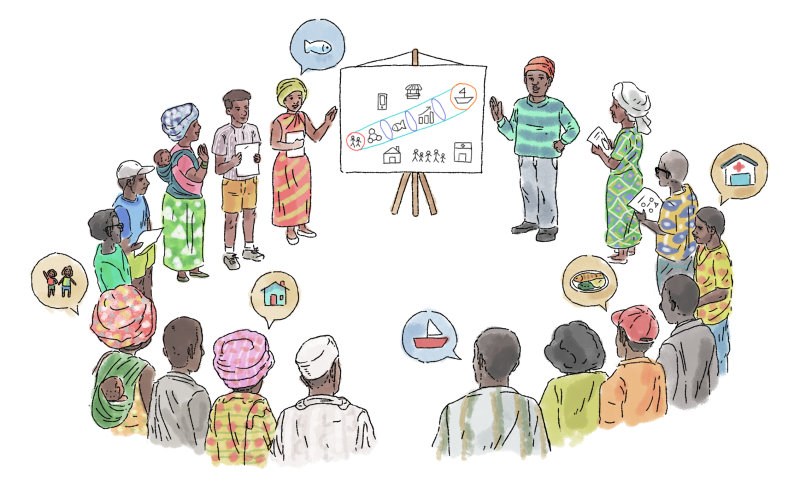
The Small-Scale Fisheries Academy first launched and tested in Senegal with Mundus maris provides a safe, respectful dialogue space bringing together different actors to co-create solutions to identified problems. It helps to operationalise the SSF Guidelines and inclusive governance.
Finally, the reviewed papers highlight the importance of participatory approaches and the strengthening of artisanal fishing communities. The FAO Voluntary Guidelines for Small-Scale Fisheries (2015) promote management models in which local communities are actively involved in decision-making about marine resources.
Conclusions
The problem analyzed from the documentary shows a particular case that can be recognized in many other marine regions of the world where fishing resources are intensively exploited. Overfishing is not only an ecological crisis, but also an economic and social one, as it directly affects the food security, employment and stability of millions of people.
The case of Senegal shows how the uncontrolled exploitation of marine resources can generate loss of ecosystem resilience, decrease in biomass and profound alterations in food webs. At the same time, it shows how technological and economic inequalities between artisanal and industrial fishing favor processes of social exclusion, impoverishment and migration.
The role of the State is fundamental to protect both marine resources and the interests of local communities, including those linked to their cultural identity. The existence of international agreements and fisheries regulations is not enough if there are no effective mechanisms for oversight, scientific monitoring and control over industrial fleets and illegal fishing.
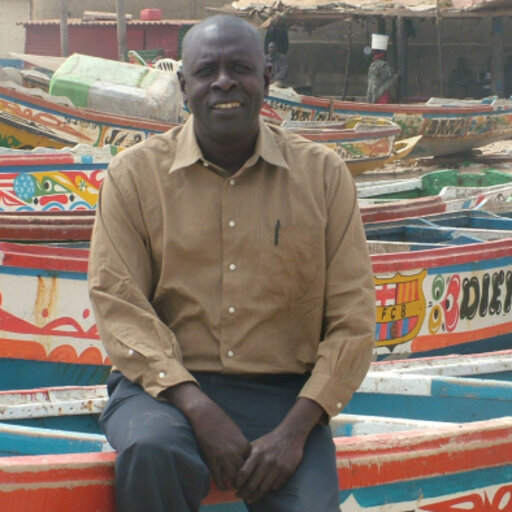
Aliou Sall
This point was deepened through a video-conference with Dr. Aliou Sall, socio-anthropologist specialized in fisheries in Senegal, held on May 27. Their contribution allowed a better understanding of the cultural dimension of fishing in Senegalese society and broadened the analysis beyond economic, ecological and environmental approaches. He also stressed the need for strong governance, articulated between the scientific sector, fishing communities and a cohesive social fabric, to develop measures to sustain this central activity for the Senegalese people.
The case also demonstrates the importance of deepening scientific knowledge about marine ecosystems, including the population dynamics of exploited species, the location of breeding areas, and ecological interactions within food webs. This knowledge is essential for designing sustainable management policies capable of conserving marine resources for future generations and, with them, a fundamental part of Senegal’s cultural heritage.
Finally, Senegal’s fisheries crisis demonstrates that there can be no environmental sustainability without social justice and effective governance. Fisheries should be understood as a complex system in which marine ecosystems, human communities, global markets and political institutions interact. When any of these components fail, the consequences extend to the entire system.
Acknowledgement
The authors would like to thank Dr Aliou Sall for the valuable video-conference from Senegal, whose insights contributed greatly to a deeper understanding of the ecological, social and cultural dimensions of artisanal fisheries in West Africa.
References
Sall, A. (2026, 27 de mayo). Fisheries crisis in Senegal. Universidad de Belgrano. https://docs.google.com/videos/d/1yr750XTYOW1eHYCHkoLkwXjzFz1aHYk_3SSen3PoGE M/edit?usp=sharing
Chaboud, C. (1983). La commercialisation du poisson au Sénégal. ORSTOM.
Dème, E. B., Failler, P., Dème, M. & Panfili, J. (2023). Contribution of small-scale migrant fishing to the emergence of the fishmeal industry in West Africa: Cases of Mauritania, Senegal and the Gambia. Frontiers in Marine Science, 10, 871911. https://doi.org/10.3389/fmars.2023.871911
FAO (2015). Directrices voluntarias para lograr la sostenibilidad de la pesca en pequeña escala en el contexto de la seguridad alimentaria y la erradicación de la pobreza. Organización de las Naciones Unidas para la Alimentación y la Agricultura.
Ferraro, G., Brans, M., Dème, M. & Failler, P. (2011). The establishment of marine protected areas in Senegal: Untangling the interactions between international institutions and national actors. Environmental Management, 47(4), 564–572. https://doi.org/10.1007/s00267-010-9602-4
Gilman, E., Pérez Roda, A., Huntington, T., Kennelly, S. J., Suuronen, P., Chaloupka, M., & Medley, P. A. H. (2020). Benchmarking global fisheries discards. Scientific Reports, 10, 14017. https://doi.org/10.1038/s41598-020-71021-x
Hilborn, R. & Ovando, D. (2014). Reflections on the success of traditional fisheries management. ICES Journal of Marine Science, 71(5), 1040–1046. https://doi.org/10.1093/icesjms/fsu034
Kadfak, A. & Antonova, A. (2021). Sustainable networks: Modes of governance in the EU’s external fisheries policy relations under the IUU Regulation in Thailand and the SFPA with Senegal. Marine Policy, 132, 104656. https://doi.org/10.1016/j.marpol.2021.104656
Pauly, D., Christensen, V., Dalsgaard, J., Froese, R., & Torres, F. Jr. (1998). Fishing down marine food webs. Science, 279(5352), 860–863. https://doi.org/10.1126/science.279.5352.860
Pauly, D., Nauen, C. E., Le Manach, F., Palomares, M.-L., Sumaila, U. R., & Lopez-Ahedo, I. (2025). From science to conscience: The plunder of Senegal’s fisheries resources, or Europe’s role in the making of a migration crisis. Proceedings of the Paris Institute for Advanced Study, 21. https://doi.org/10.5281/zenodo.15833918
Sall, A. & Sow, O. (2025). A situational analysis of small-scale fisheries in Senegal: Livelihoods, gender and governance in the context of globalization and climate change. V2V Working Paper 2025-01. V2V Global Partnership, University of Waterloo.
Samba, A. & Chauveau, J.-P. (1990). Dynamiques sociales et commercialisation des produits halieutiques artisanaux au Sénégal. ORSTOM.
Accademia della Pesca Artigianale
- Mundus maris presents the SSF Academy in Ghana at the 3rd SSF Summit in Rome
- Restoring Ghana’s fisheries starts with the people who depend on them
- Small-Scale fisheries should be a big part of the future in West Africa
- Plunder in the Atlantic: When Overfishing Threatens the Sea and Coastal Communities
- Our Power, Our Planet – Celebrating Earth Day Webinar
- Mundus maris all’EGU26, 3-8 maggio 2026
- Mundus maris at the aspirational 5th World SSF Summit, Thailand
- Trasformare un’erbaccia acquatica in una fonte di reddito
- Pescatori artigianali e ambientalisti ripensano insieme la pesca
- Make Fishing Fair
- La pesca eccessiva straniera alimenta la mortale crisi migratoria del Senegal verso l’Europa
- Mundus maris at MARE 2025
- I pescatori artigianali al centro della governance dell’oceano e della sicurezza alimentare
- Make Fishing Fair in the EU, 25 March 2025
- Human – Biodiversity Relationships Across Scales
- World Fisheries Day, 21 November 2024, celebrated in Nigeria
- Mundus maris partecipa al 2024 World Fisheries Day organizzato dalla Canoe and Fishing Gear Association del Ghana (CaFGOAG).
- Mundus maris contribution to the UNOC3 public consultation
- Vertice sulla pesca artigianale a Roma, 5-7 luglio 2024
- Regional Symposium on European Small-Scale Fisheries, Larnaca, Cyprus, 1-3 July 2024
- Riunione di emergenza sulla pesca nel Baltico, Bruxelles, 26 giugno 2024
- Ambivalent role of Market and Technology in the Transitions from Vulnerability to Viability: Nexus in Senegal SSF
- Shell fisheries as stewardship for mangroves
- Giornata mondiale della pesca, 21 novembre 2023
- Webinar: Nigeria’s Fisheries challenges and opportunities
- Presentazione della FishBase app al Symposium di Tervuren
- Convegno MARE sulla paura blu – Mundus maris riflette
- The Transition From Vulnerability to Viability Through Illuminating Hidden Harvests, 26 May 2023
- Sessioni EGU focalizzate su geoetica e apprendimento congiunto
- Solidarietà con i pescatori artigianali in Senegal e Mauritania
- The legal instruments for the development of sustainable small-scale fisheries governance in Nigeria, 31 March 2023
- Tools for Gender Analysis: Understanding Vulnerability and Empowerment, 17 February 2023
- Community resilience: A framework for non-traditional field research, 27 January 2023
- Sustainability at scale – V2V November webinar
- Edizione africana del 4WSFC a Cape Town, 21-23/11/22
- Edizione Europea del 4WSFC in Malta, 12-14 Settembre 2022
- Mundus maris contribuisce all’SSF Summit in Roma
- Donne commercianti di pesce a Yoff e Hann in Senegal, vittime o artefici del loro destino?
- L’Accademia continua il suo lavoro a Yoff
- Illuminating the Hidden Harvest – a snapshot
- Virtual launch event FAO: International Year of Artisanal Fisheries and Aquaculture
- The Small-Scale Fisheries Academy as a source of operational support to PA Guidelines
- Congresso mondiale della pesca, Adelaide, 20-24 settembre
- Mundus maris sostiene la lotta di Paolo il pescatore, in Toscana, Italia
- Catching-up – SSF Academy Yoff, 27 Febr. 2021
- Rafforzare le capacità degli attori per una pesca sostenibile su piccola scala
- Sperimentazione dei metodi di formazione durante la fase pilota dell’Accademia SSF in Senegal
- Una prima assoluta: il lancio di un’Accademia della Pesca su Piccola Scala in Senegal