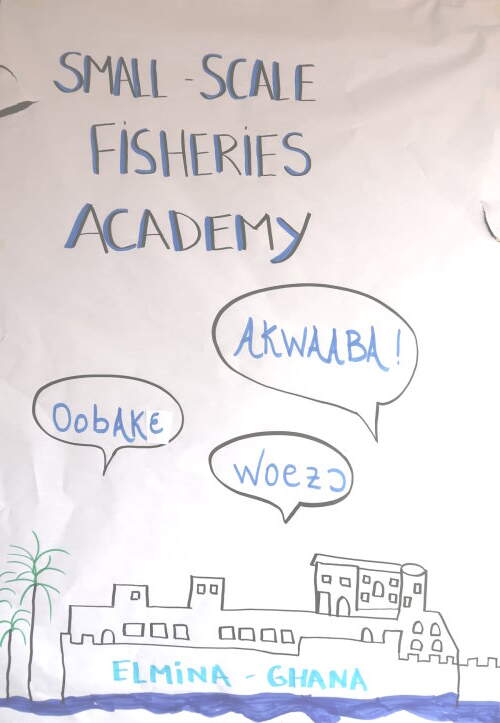
 From 28 September to 2 October 2026, the Small-Scale Fisheries Academy in Ghana convened its second workshop for community dialogue meetings in support of co-management. This time, the Academy practitioners met in Elmina, Central Region, as a result of the partnership between Mundus maris and the Canoe and Fishing Gear Owners Association of Ghana (CaFGOAG).
Eight national trainers (two from each coastal region), 20 regional trainers (five for each region, including one officer of the Fisheries Commission), and a policy director from the ministry together with the Mundus maris team and the CaFGOAG coordinator drew lessons from the experiences with first two or three community dialogues in eight pilot villages. Two researchers, one from the University of Bern, Switzerland, the other one from the University of Cape Coast participated in the first two days of the workshop.
The first group discussions were among facilitators across different regions to support peer learning. The starting question was: What has changed in the communities in the last two to five years.
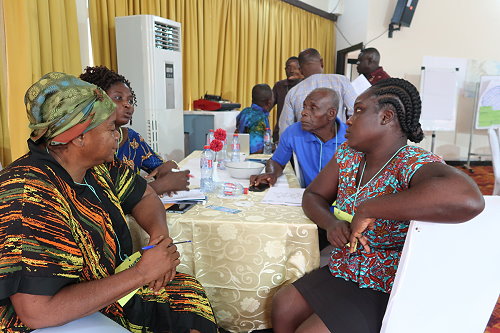
Intensive discussions in small groups with participants from several regions to encourage peer learning
Among the observations that were common, shrinking resources, substantial catches of juveniles, increasing illegalities, weak enforcement of rules, and loss of price fixing capacity of the Queen Fishmonger, the Konkohemaa as the most powerful woman in the community, stood out.
The next question was ‚what do you know about the new Fisheries and Aquaculture Act‘? The conversations were quite animated as participants highlighted particularly those aspects, often in considerable detail, that concerned their profession directly. Among the points raised were the extension of the exclusion zone from 6 to 12 nautical miles, increase in licensing requirements for all professions, prohibition of catching juveniles, increased penalties for illegal fishing or other ways of breaking the law, the setting up of central co-management committees to cover scientific, managerial and traditional knowledge matters, and a special fisheries and aquaculture development fund.