An encounter with Martina Gaglioti, an inveterate ocean lover, who takes us on a discovery trip, not so much into the extensive scientific literature, but to some overwhelming first hand experiences in the beautifully regenerated Cabo Pulmo National Park, Southern Baja California, Mexico.
Martina’s experience is a telling complement to a news feature article by science writer Aisling Irwin, recently published in Nature, which questioned the wisdom of conducting more and more lab-based data crunching at the expense of real field experience and exposure to nature. Martina is no stranger to scientific analyses, but she argues that we must not lose the connection to the sea and the wonders of its amazing creatures. Let’s hear from Martina first hand.
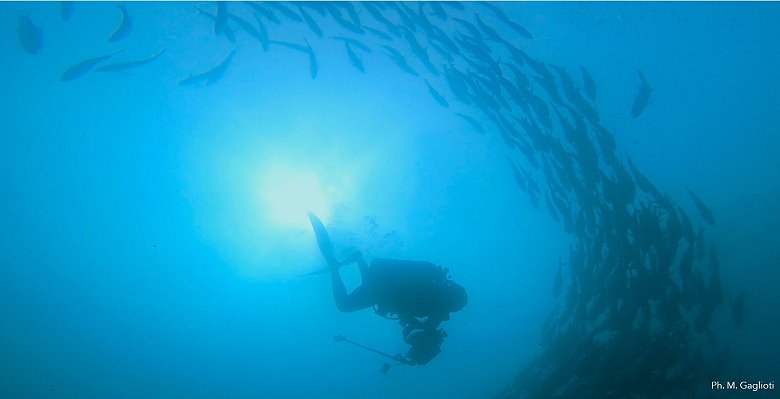
Q: Martina, we met (again) at the Boot 2026 Fair in Düsseldorf in January, where you participated, just like Mundus maris on the ‘Love your Ocean’ Platform. You presented a lovely visual account of your dive trip to Cabo Pulmo in December 2025, which attracted a lot of attention. Tell us a bit about your choice of travelling all the way to Mexico to dive with your pals.
A: I joined a “women-led expedition” there. It was actually my birthday gift, not a working mission. This was also a way to celebrate a year of commitment as a Co-chair of the UN Decade Gender Expert Working Group and to advance a bit of my field commitment as a UNESCO Earth Network expert focusing on the Man and Biosphere Program and working for sharks and rays conservation (especially in the last few years). Cabo Pulmo is a well-known example of a successful community-led conservation initiative and I always had heard many tales about this place. I was thus curious to see this place in person and see how the precautionary rules were applied. And I was impressed how strictly they were respected, surely a major contribution to recovering biodiversity in the national park.
The general rules adopted in the Cabo Pulmo National Park were the same generally valid for a good diver to minimize the impact with the seabed and the marine life, including a max number of divers per site and per day, a minimum certification level for some spots, and a mandatory maximum time of 45 min per each dive.
Also, in La Paz the rules were specifically set by the Park authority since the approach to the whale sharks can happen solely by snorkelling. Wearing a wetsuit is mandatory since the free-diving to approach the animals is strictly forbidden. Also only few boats are authorized. Only one boat at a time can approach the animal. So, once the captain sights the whale shark his boat becomes the only one allowed to approach the animal. Any other boat needs to turn away, possibly searching for another animal.
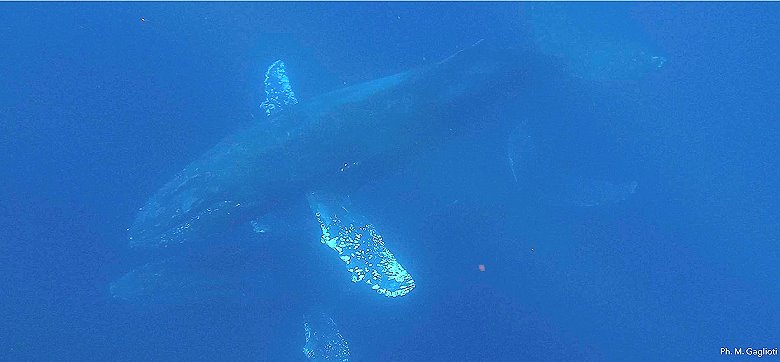
Humpback whale with calf
The ecotourism activities are only allowed using licensed operators and limiting interaction to 5 snorkelers per guide. Snorkelers must maintain a 2-meter distance to the side of the whale shark (3-4m from tail). Touching is prohibited as is flash photography.
Q: Indeed, regenerating marine biodiversity and functioning ecosystems was not a major concern only a few decades back when extractions and short-term profits dominated the approach to ocean resources of industries. You must have been satisfied to see what a different approach more in line with respecting marine life can achieve.
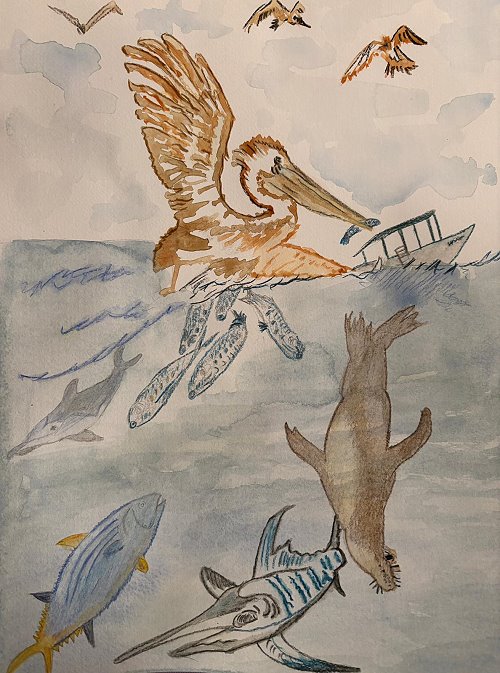
All gorge on the sardines (Watercolour by Martina Gaglioti)
A: The biomass of sardines in the past was much higher. As far as I know the sardine run currently happens closer to the shores. The people who observed it in the past said in the previous expedition that they had to travel beyond the area we were, definitely off the coast, to observe similar densities.
The sardine run in Baja California, primarily involving Pacific sardines (Sardinops sagax) aggregating off the western coast in areas like Magdalena Bay, has been indirectly altered by intense fisheries pressure in the nearby Gulf of California. Overfishing has caused repeated fishery collapses there—four times in the last 30 years—reducing sardine abundance and potentially disrupting migration patterns and spawning stocks that support the run.
The Gulf of California sardine fishery, centered around Guaymas, boomed in the 1960s–1980s but collapsed in 1991 (from 300,000 to <10,000 tonnes), with further busts in 1998, 2004, and around 2013. Fishing effort and environmental factors like El Niño and the Pacific Decadal Oscillation (PDO) are equally responsible. Models show that overfishing exacerbates declines during poor environmental conditions.
Lower sardine biomass as a result of Gulf fisheries likely reduces the scale of aggregations during Baja California’s seasonal run (October–January), affecting predators like striped marlin, sea lions, and whales that rely on these schools. While the run persists as a “secret” frenzy off Baja Sur, historical overexploitation halted northern migrations in similar California Current systems, suggesting vulnerability. So, strictly protected areas are helping to rebuild biomass of sardines and other parts of the food web and in turn allow the system to cope a bit better with El Niño phases and ongoing climate change effects.
Q: You have had the opportunity to dive from your early childhood. That is not given to everybody. How did this influence your choice of studies and outreach?
A: I consider it the greatest privilege I had in my life. It is actually the unique truly inspiring reason why I’m still committed to marine conservation and marine research. Being a diver since when I was a kid, and growing up at the seaside (actually in a Biosphere Reserve), allowed me to discover the beauty of the sea in a uniquely genuine and pure way. Something that is not as easy to experience when you approach the Ocean for work or you are excessively influenced by working-life or, even worse, by constraints of “citation rush”.
Q: What made your stay in Cabo Pulmo during the Sardine run special?
A: First of all the spirit of the group: all the expedition members are great passionate of marine life, truly focused on what we were experiencing even without being academic people or marine scientists. Also, the main goals we had was looking at incredible places and running the expedition to see in person a special phenomenon as the sardine run definitely is.
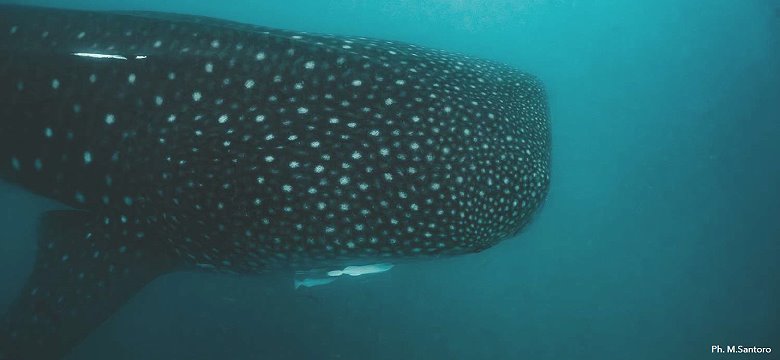
Eye to eye with a whale shark
Can you imagine, how wonderful it was swimming so close to a whale shark. It gave us a great sense of peace! Despite being the largest fish of the Ocean it is not scary at all. The whale shark (Rhincodon typus) is a filter feeder. Also, it seems swimming so slow. But being there and swimming to keep its pace, is not as easy as you might imagine. You need to be a good swimmer!
I have to say I was positively impressed by the precautionary modalities and enforcement of divers etiquette. In other places in the world, I know the impact and disturbance of the whale sharks by divers is definitely higher. In some places, the locals are used to feed the animals to attract them. This is absolutely not the case in Mexico.
Q: What most impressed you besides the outstanding experience of being immersed with wild life like sardines, swarms of horse mackerel and their formidable predators?
A: I was impressed by nature of course, but also from the ability of the local community to run incredibly engaging tourism activities without interfering with marine and coastal ecosystems so deeply as happens in localities famous for diving or other “blue tourism” activities which actually are not so “blue” at the end of the day. Honestly, I didn’t expect to find some best practices as those experienced in La Paz or even to see so dedicated and environmentally aware local people, such as our Panga captain or the fishermen who hosted us in their village during the sardine run.
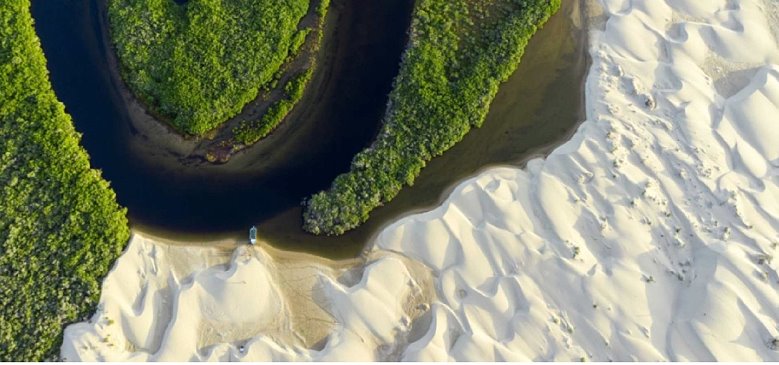
Coastal desert and fringing mangroves – the amazing landscapes on the Pacific side of Baja California
I have to say, as marine biologist, I wasn’t blindly impressed only by the positive aspects. I saw also something I honestly wished not to see: for example the quite harassing recreational fishing activities running exactly in the sardine run action spots. Something we definitely have to work on in the near future.
Q: Some recent studies suggest that where recreational fisheries are strong – also as a source of income, with or without competition with different commercial fisheries – the average size of fish species increase, particularly those that are targeted by the recreational fishers. They want big fish. They may, paradoxically, thus help to reverse the downward trend in fish sizes, mostly as a result of overfishing, now in combination with climate change induced warming ocean waters. Did you observe any of that during your trip?
A: During our trip of course we came also through big schools of jacks in Cabo Pulmo (video), pretty huge schools of sardines during the sardine run action in Magdalena Bay and many marlins preying on them. It was there that we encounters also many recreational fishermen: they declared to be there solely for catch and release activity targeting marlins.
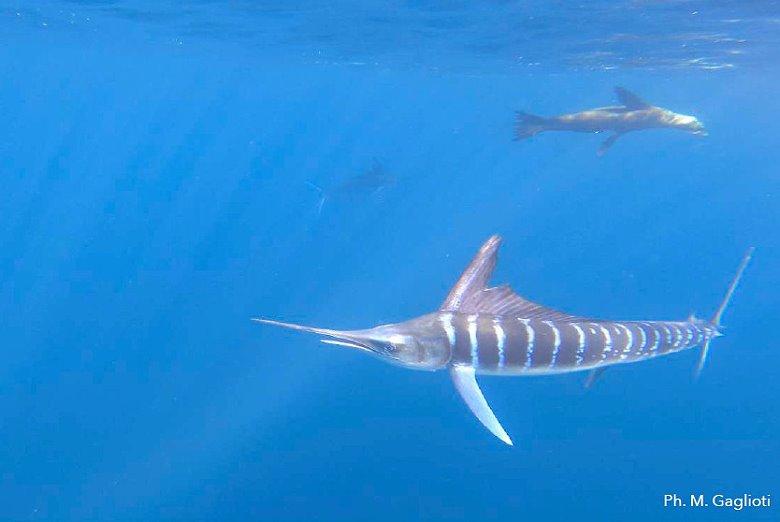
Hunting marlin
This year for the sardine run in Magdalena Bay we were far away from the coast, around 25-30 nm off the coast due to the prevailing temperatures. The main fishermen I saw were recreational fishers in speed boats from North America doing this catch-and-release activity. They approached the bait balls to catch the big marlins in the hunting phase. Also, they were using some free divers with the surface buoys to approach the bait balls, I guess to do spearfishing as well. I don’t know the details on their techniques. But for us it meant to navigate off the coast to be safe during our observations and away from their lines to avoid being trapped too.
Q: The booklet you put together about your dive trip includes some beautiful watercolours you painted to render the beauty of the sea also in artistic terms. What gave you the idea to combine photography with a rendering through watercolours?
A: I think art in all its forms is always a powerful communication tool. What we are notu able to communicate through a scientific paper maybe is easier to be delivered through a drawing, a sculpture or a song. To be honest the booklet was born during my Christmas break. I started with a watercolour on the whale shark encounter (which was at the top of my bucket list for this expedition), then I ended up with a dozen of them, highlighting all the key encounters of the field expedition. Therefore, I decided to merge some pictures with the watercolours series and to write a short story to share this experience with those interested in hearing about that. I thought of kids and high school teens as my main target audience, but I think it is suitable also for divers or other adults.
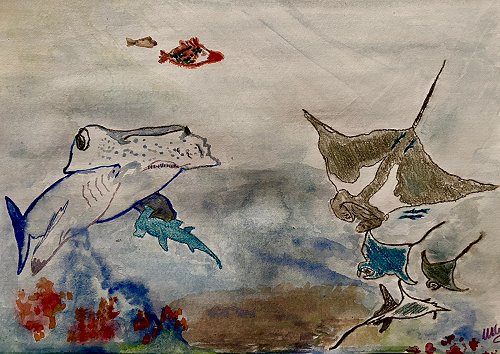
A hammerhead and mantas at the rendez-vous
Q: What are your next plans to entice more people to reconnect with the sea?
A: Despite the fact that we are now mostly living in cities, we also live in the epoch of blue education and ocean literacy momentum. I think the human connection to the sea is something natural. We are almost all fascinated or attracted by the sea. I challenge everyone to see an underwater photography or a colourful marine seascape and not appreciate it.
I spoke with thousands of people in my life about my childhood passion and my daily commitment to marine conservation and I never found it hard to see fascination in their eyes hearing my tales or looking at some underwater pictures I was showing them. In the near future, I’ll keep interacting with all those showing a respectful attitude toward all the efforts done so far. I’ll be glad to collaborate to address knowledge gaps with those who wish to do that: I’m always a fan of bottom-up engagement even in my outreach activities. I do not like at all the role of “top-down teaching researchers” and even less the word “expert”, even if for work sometimes we are perceived this way especially from the not academic audience. At sea we are always all learners, even if we reached the highest citation scores!
Q: Thanks for sharing your story. We do hope that it will inspire more people to rediscover the beauty of the sea first hand and help to regenerate its health.
A: Thank you for expressing your curiosity about it! It was nice to share some thoughts with you and your readers.
The questions for Mundus maris were put forward by Cornelia E Nauen.