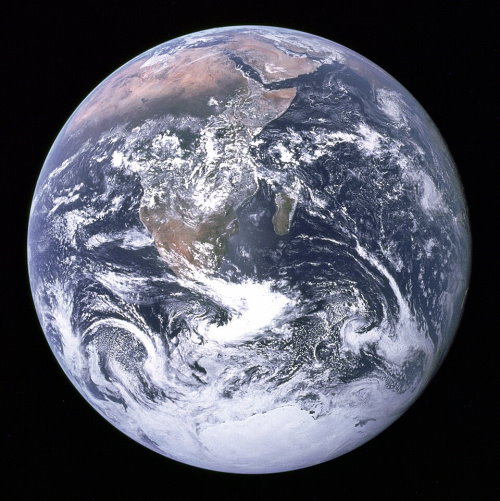
« La boule bleue », photographiée en 1972 par Harrison Schmitt, membre de l’équipage d’Apollo 17. La photo originale avait été prise avec le pôle Sud en haut de l’image ; c’est cependant cette version qui a été la plus largement diffusée.
En 1972, l’équipage d’Apollo 17 a pris la célèbre photo de notre planète bleue composée à 71 % d’océan, le plus grand écosystème interconnecté, soit environ 99 % de l’espace vital en volume. Avec, plus de deux millions d’espèces estimées, son rôle de régulateur du climat et de producteur de plus de la moitié de l’oxygène présent dans l’atmosphère, sans parler de son importance pour l’alimentation, le commerce, l’emploi et les loisirs, l’Océan est essentiel à la vie sur Terre et aux civilisations humaines.
L’exposition, organisée avec brio par Katharina Chrubasic et Agnieszka Lulińska, et généreusement soutenue par l’institut GEOMAR Helmholtz Center for Ocean Research de Kiel, son partenaire scientifique, proposait un mixte captivant mêlant sciences marines et exploration depuis les origines jusqu’à nos jours, l’exploitation et la protection des ressources marines, ainsi que l’art, l’aventure et les mythes liés aux sept mers.
Dès les années 1960, Elisabeth Mann Borgese lançait cet avertissement : « Nous devons sauver l’océan si nous voulons nous sauver nous-mêmes ». Cette exposition revêt donc aujourd’hui une importance encore plus grande, à une époque où les écosystèmes marins sont gravement menacés par la surexploitation, la pollution, les effets du changement climatique et l’aggravation des inégalités sociales et économiques.
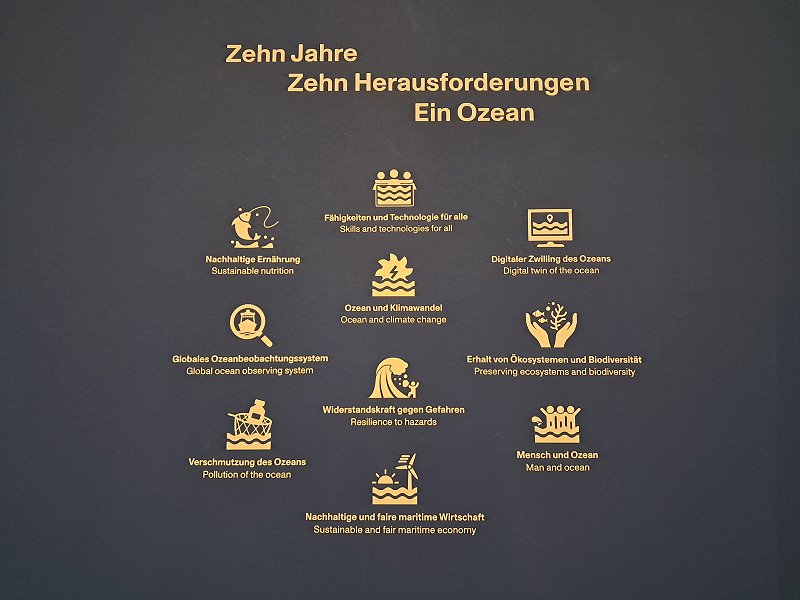
Pensez également au mi-parcours de la Décennie des Nations Unies pour l’océan (2021-2030) – 10 ans, 10 défis, 1 océan – et vous obtenez un excellent cadre pour l’exposition « Expedition Weltmeere » à la Bundeskunsthalle de Bonn.
Les quelques photos présentées ci-dessous donnent un aperçu des différentes composantes de l’exposition : depuis les magnifiques photos jusqu’aux spécimens de poissons conservés au musée, en passant par les étonnantes maquettes en verre représentant des organismes fragiles des profondeurs marines, réalisées avec brio par le duo père-fils Leopold et Rudolf Blaschka. Chaque spécimen nous rappelle à quel point nous avons encore beaucoup à apprendre sur l’océan. Ci-dessous, une photo de Phronima sedentaria, un crustacé également surnommé la « super maman » en raison de la façon dont cette espèce protège sa progéniture.
Les quelques photos présentées ci-dessous donnent un aperçu des différentes composantes de l’exposition : depuis les magnifiques photos jusqu’aux spécimens de poissons conservés au musée, en passant par les étonnantes maquettes en verre représentant des organismes fragiles des profondeurs marines, réalisées avec brio par le duo père-fils Leopold et Rudolf Blaschka. Chaque spécimen nous rappelle à quel point nous avons encore beaucoup à apprendre sur l’océan. Ci-dessous, une photo de Phronima sedentaria, un crustacé également surnommé la « super maman » en raison de la façon dont cette espèce protège sa progéniture..
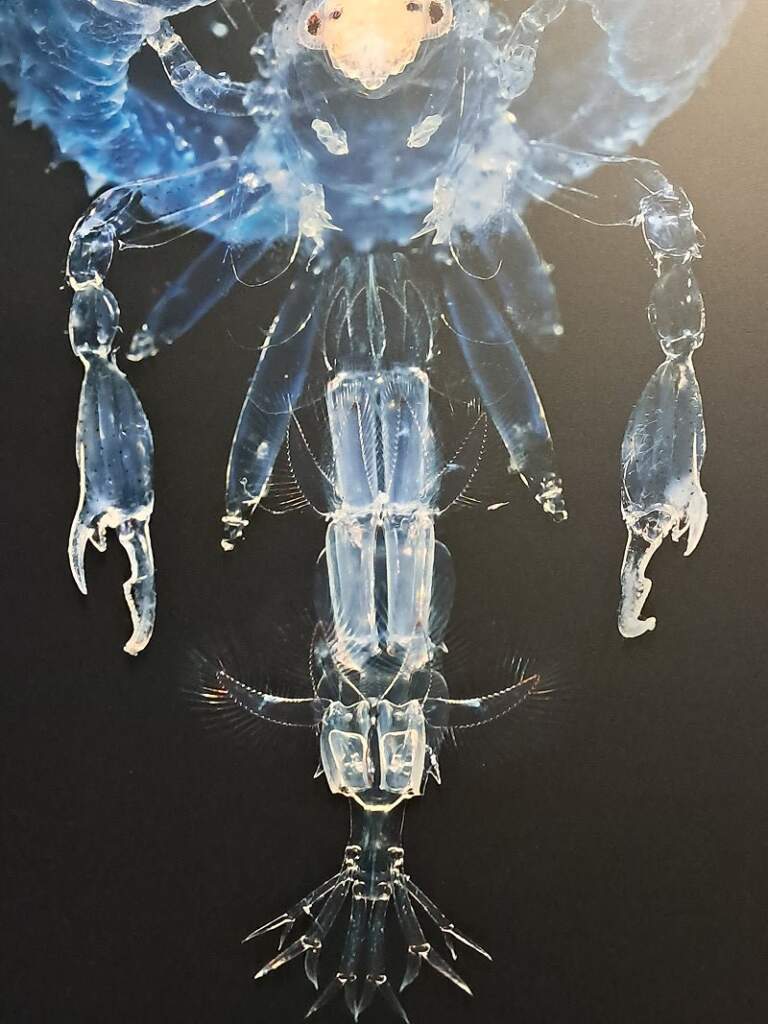
Phronima sedentaria, un amphipode des grands fonds, crustacé pouvant atteindre 6 cm de long. Elle vide un salpe pour protéger ses petits, qu’elle transporte dans cette sorte de « tonneau-landau »
À l’inverse, dans les eaux superficielles baignées de lumière, Palmaria palmata est très répandue dans les zones de marée et intertidale de l’Atlantique et du Pacifique Nord. Elle est consommée comme snack depuis des siècles dans de nombreuses régions.
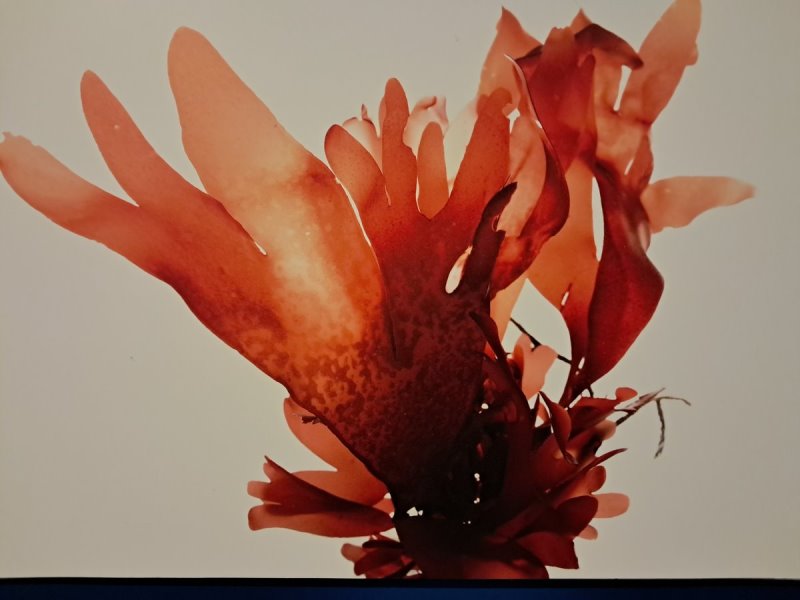
Palmaria palmata, communément appelée ulve rouge, est une algue rouge que l’on trouve dans la zone intertidale des eaux tempérées et froides
En parcourant les salles d’exposition, on ne peut s’empêcher d’éprouver un profond respect pour ces personnes courageuses et curieuses qui ont contribué à façonner notre connaissance actuelle de l’océan, en accumulant observations, récits et innovations ; pourtant, plus nous explorons grâce aux moyens modernes, plus nous prenons conscience de tout ce qu’il reste encore à étudier, à documenter et à partager avec patience et attention.
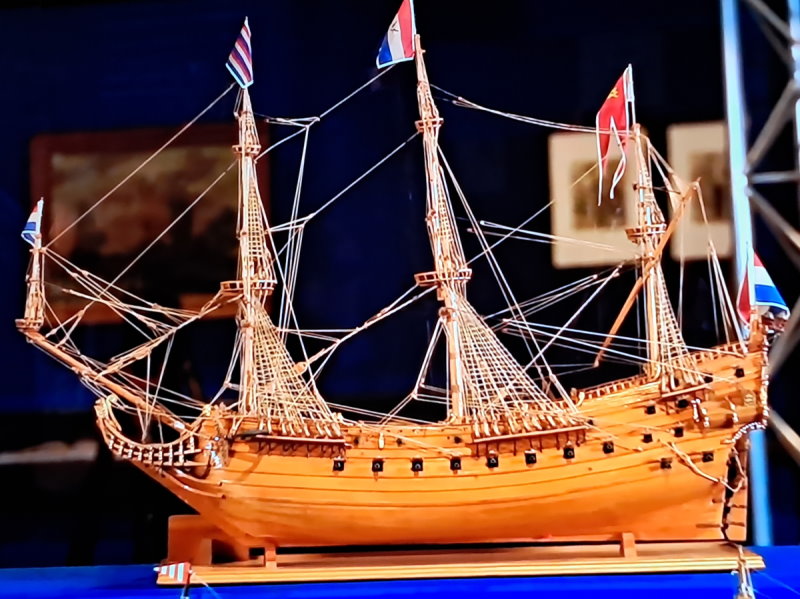
Voilier historique
Les conditions de vie à bord des voiliers historiques n’ont rien à voir avec celles d’un navire de recherche moderne ou d’un immense porte-conteneurs sillonnant les océans grâce à de puissants moteurs et à la navigation par satellite.
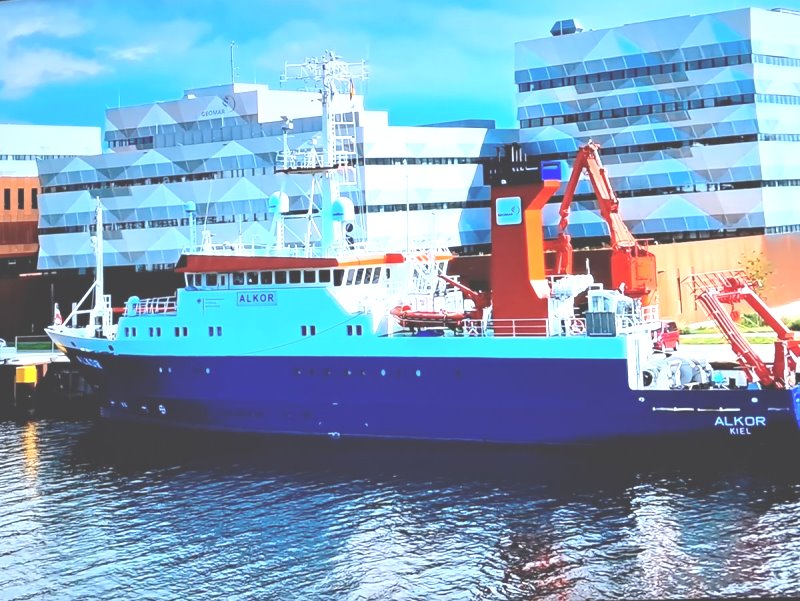
Le navire de recherche Alkor à quai devant l’Institut GEOMAR, à Kiel
L’océan a toujours stimulé l’imagination et suscité toute une palette d’émotions, allant de la peur et de la crainte à la fascination et à la joie. Ses étendues infinies continuent aujourd’hui encore de nous émerveiller, malgré les moyens technologiques dont nous disposons. Nous avons pris conscience, bien trop tard, que ses ressources ne sont pas inépuisables, contrairement à ce que l’on croyait il y a moins d’un siècle. Aujourd’hui, il est impératif de redonner à l’océan sa santé et sa richesse.
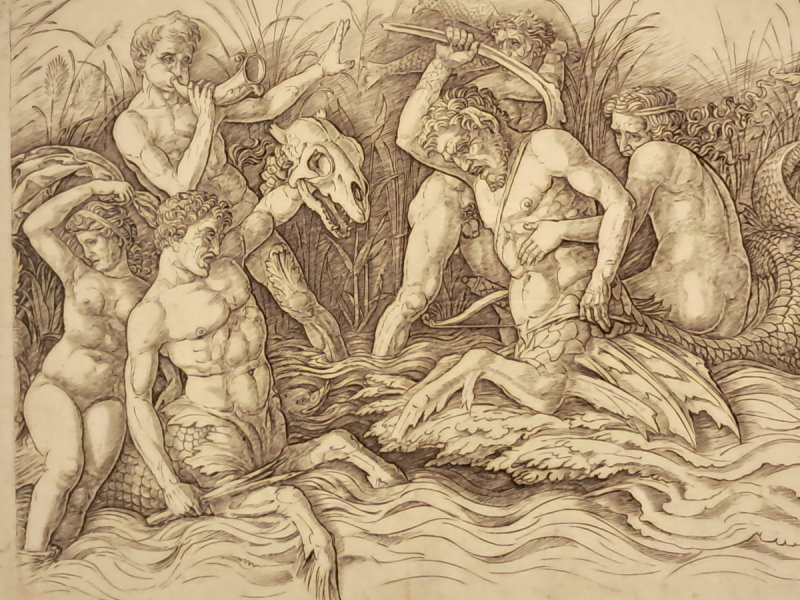
Le Triomphe de Neptune, Marco Angelo Del Moro, XVIe siècle
Les dégâts que nous avons déjà infligés à l’océan se reflètent dans la quasi-extinction de nos cousins, les baleines. Cependant, depuis l’entrée en vigueur, en 1986, du moratoire de la Commission baleinière internationale sur la chasse commerciale à la baleine, plusieurs espèces montrent des signes timides de rétablissement. Aujourd’hui, les activités humaines font peser un risque d’extinction sur de nombreuses espèces marines. Nous ne pouvons donc pas rester les bras croisés, nous contenter de pleurer sur notre sort ou détourner le regard. Il ne s’agit pas d’une lutte entre les dieux pour le contrôle du royaume marin, comme on le croyait peut-être dans l’Antiquité. La plupart des maux actuels découlent de notre incapacité à assumer une gestion responsable à la hauteur des moyens exceptionnels dont nous disposons. Nous devons étudier, comprendre et aider l’océan à se régénérer.
L’exposition a également montré comment les arts peuvent favoriser une prise de conscience et une mobilisation accrues. Les artistes et scientifiques australo-américaines Margaret et Christine Wertheim ont par exemple lancé en 2005 le projet d’installation artistique « The Hyperbolic Crochet Coral Reef » afin d’attirer l’attention sur le blanchissement des coraux de la Grande Barrière de Corail dans un océan en réchauffement. Depuis de nombreuses années, elles encouragent des citoyens du monde entier à reproduire, sous forme de crochets, l’incroyable diversité des organismes des récifs coralliens. Plus de 40 installations de grande taille sont le fruit de cette vaste collaboration.
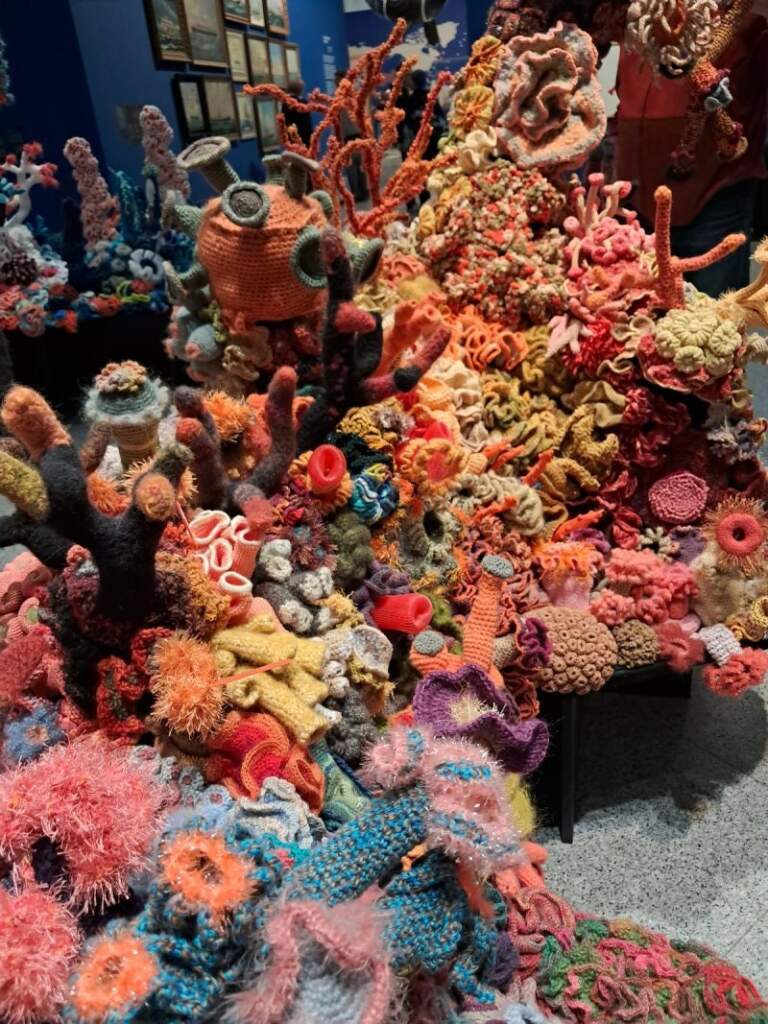
Les récifs coralliens se développent grâce à la collaboration de millions de polypes et d’autres organismes ; cette représentation au crochet du musée Frieder Burda, à Baden-Baden est, elle aussi, le fruit d’une coopération à grande échelle
L’exposition a ouvert ses portes le 2 octobre 2025 et s’achèvera le 6 avril 2026, avec pour conclure une série d’ateliers et de visites guidées. Elle met en parallèle la première descente dans la fosse des Mariannes effectuée par Don Walsh et Jacques Piccard en 1960 avec le roman « Vingt mille lieues sous les mers » du poète et écrivain de science-fiction français Jules Verne, publié près d’un siècle plus tôt. Les visiteurs ont été surpris d’apprendre que le saumon de l’Atlantique – un incontournable de la cuisine européenne – peut atteindre 150 cm à l’état sauvage. Notre App FishBase Guide app est un excellent outil pour connaître la taille maximale des poissons de votre région, partout dans le monde, et pour connaître la période à laquelle ils commencent à se reproduire et… ainsi être certain de ne pas manger de bébés.
En résumé, l’exposition proposait de nombreux points d’entrée pour éveiller la curiosité à l’égard de l’océan et encourager la participation. Pour tous ceux qui souhaitent en savoir plus sur l’océan et son influence sur notre culture, ses récits et ses connaissances scientifiques, ce magazine richement illustré offre des informations contextuelles, des explications, des réflexions et des éléments de fond. Il est toujours disponible. Source: Kunst- und Ausstellungshalle der Bundesrepublik Deutschland. Expedition Weltmeere. Magazin zur Ausstellung. 2025. Hirmer Verlag. 193 S. ISBN 9-783777-446820.
Pour décharger l’App FishBase Guide: cliquez ici.
Impressions et phtos de C.E. Nauen, mars 2026