Five years into the implementation of the EU Mission ‘Restore Our Ocean and Waters’ and less than one year since the announcement of an ‘EU Ocean Pact’ at the UN Ocean Conference in June 2025 the week-long EU Ocean Days 2026 in Brussels fielded a large number of meetings in several venues. Throughout the week, panelists and other speakers grappled with seeking to strike a balance between paying heed to different local contexts, whether they be environmental, economic, technological, social, or institutional, while aggregating knowledge, skills, finance, operational capacities, and governance at European and wider international levels to respond more adequately to today’s and future challenges.
In the session on Marine Knowledge for Ocean Health on 3 March, Manfred Zeiler of the German Federal Maritime and Hydrographic Agency argued in favour of strengthening systematic cooperation in Europe not only through short-term research projects, no matter how valuable, but regularly among institutions with ocean observation mandates.
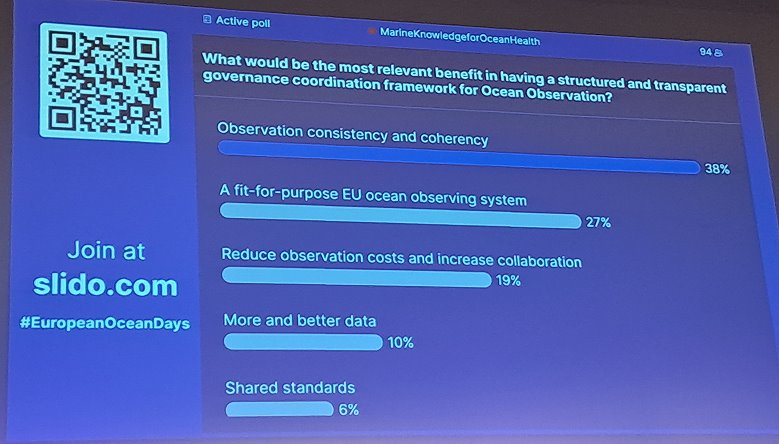
The most important concerns of the session participants were expressed in the slido poll
José Miguel Rubio Iglesias of the European Environment Agency (EEA) highlighted in this context the services rendered already by the COPERNICUS Programme. But he underscored as well the challenges for the timely delivery of directly usable knowledge products posed by the diversity of actors at national level engendered by a lack of harmonised mandates and funding, except for meteorology.
The next day, panelists discussed sustaining the competitiveness of the blue economy with an eye on innovation and how to turn this into broader economic success stories.
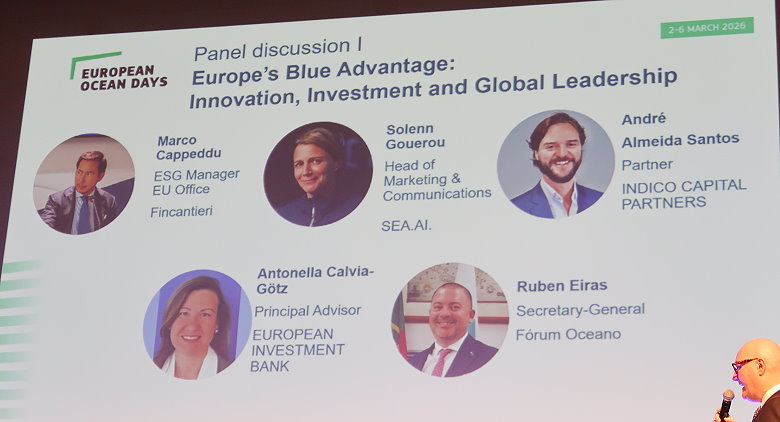
The low levels of risk capital in Europe made it difficult even for start-ups leading in important areas of technology to attract the necessary funding for up-scaling as banks were quite risk averse and bound by rules aiming at limiting risk taking. Solenn Gouerou of SEA.AI illustrated a case in point for their powerful ship-based ocean observation systems developed by teams in Austria, Portugal and France. The start-up expected to break even in the next few months, but now needed a major injection of finance to retain their leading position and expand beyond the limited market in Europe.
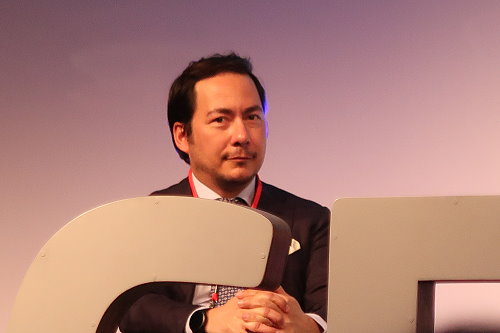 The panelists joining the conversation from the perspectives of private and institutional finance confirmed that the crucial role of finance and the time of return on investment was typically underappreciated by technology focused companies.
Marco Cappeddu of Fincantieri presented the case of a well-established industry leader in Europe focused on specialty marine constructions, not bulk carriers dominated by Asian ship yards. The company positions itself focused on innovations supporting reduced environmental impact, a different ‘game’ to capital-intensive mass production. The first hydrogen powered cruise ship is currently under construction for delivery to Viking by the end of 2026.
Asked what the company considers most important for sustaining success, the answer is two-fold: stable regulations that help first movers to introduce environment friendly solutions and balancing the need for sustainable production and consumption with international competitiveness.
In the second panel, Annika Kroon of DG MOVE spoke directly to this concern. She informed that from initially 6% of vessels with duel fuels, now 40% of ships had this propulsion to reduce emissions. This was a result of EU regulations. Unfortunately, a global extension failed at the last session of the International Maritime Organization (IMO). But that should not lead to giving up the ambition to reduce the climate impact of the shipping industry.
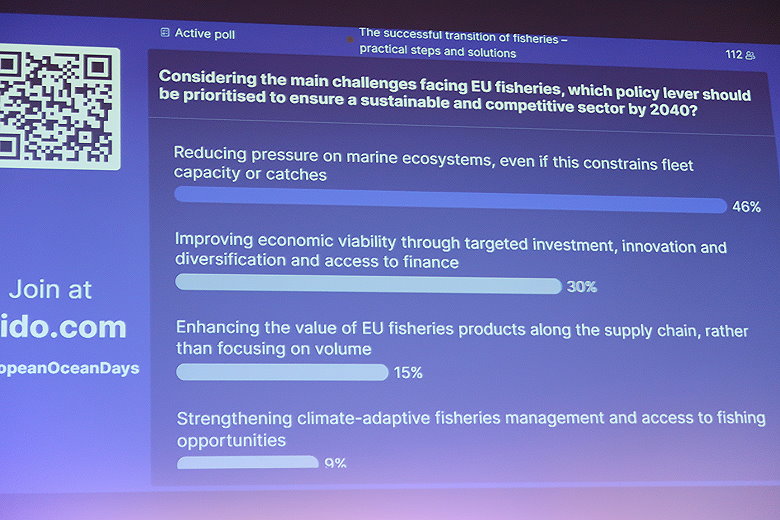
Slido poll on key levers to make fisheries sustainable and competitive by 2040
The afternoon session on Wednesday, 4 March, was dedicated towards a 2040 vision for thriving fisheries and aquaculture. It was introduced by Commissioner for Fisheries and Oceans, Costas Kadis, who reminded the participants of the importance of consumer trust, the resilience of supply, good labour conditions, and a regulatory and financial tool kit fit for purpose. The following high-level panel passionately argued to act on declining production with rebuilding stocks to make fisheries attractive for young people. Charlena Vitcheva, Director General of DG MARE recalled that the last reform leading to the current Common Fisheries Policy (CFP) mandated management to maintain stocks at levels above the maximum sustainable yield (MSY). Current fishing pressures needed to be reduced to avoid further reduction of the biomass in the water and loss of profitability. While there was a need to adapt measures to regional conditions, it was important to ensure the profitability of the professions to ensure generational renewal.
MEP Thomas Basada vigorously defended the need for supporting small-scale fisheries not only in the Mediterranean. He pleaded strongly for better international ocean governance, investment into climate resilience and a healthy ocean, and an ambitious European Ocean Act to operationalise the Ocean Pact with sufficient funding for credibility.
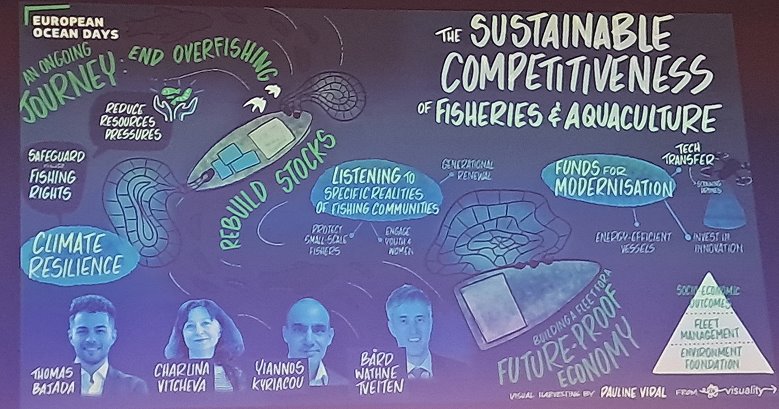
Graphical summary by Pauline Vidal
During the second panel of this session, Javier Garat as president of EUROPECHE, the industrial lobby organisation, frontally attacked Charlena Vitcheva’s presentation demanding to scrap fisheries controls and environmental regulations. He instead advocated the funding of an action plan for blue food, more subsidies for the fleet owners. That was clearly not shared by the public as shown in the slido poll above. Interestingly, in a later panel discussing coastal and island communities on 6 March, where he represented the European Economic and Social Committee (EESC) as a member and rapporteur for the European Ocean Act, he lamented the great damage inflicted to his home town near Cadiz in Andalusia by three consecutive cyclones. That is, of course, a big hardship for the people and communities affected, who need solidarity and help.
But should it not be mentioned here that bottom trawling remobilises significant amounts of CO2 and contributes substantially to the emissions of the industrial fishing and shipping industries which contribute to accelerating climate change? It should perhaps also be said that coastal communities with healthy, functioning ecosystems, such as extensive seagrass beds, suffer less storm damage than those with extensive artificial infrastructure. So, there is clearly more food for thought than may meet the eye right away. The damage sustained in regions in Portugal, Spain, Italy and beyond are certainly not only insurance cases, but an invitation to rethink how we treat the ocean and how we can take concrete action towards regeneration of healthy ecosystems. Investing in the capacity for fast regeneration of the ocean can be an important building block in shaping the future.
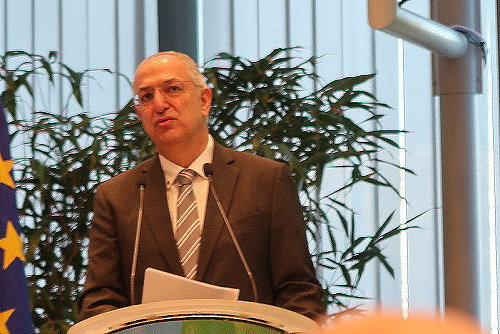 Commissioner Kadis also took the floor the following day, on 5 March, at the Mission Forum ‘Restore our Ocean and Waters’. He was pleased that so far more than €400 million had been invested at European level so far to operationalise the Mission and that the Mission Charter had already attracted more than 1000 supporters making pledges.
Mundus maris has pledged to work on the dissemination of the role play ‘Protecting Blue Horizons’ to make a marine protected area work in practice.
The Commissioner insisted that it was important to get the basics of the Ocean Pact right and that a vigorous pursuit of the Ocean Act currently the subject of several public consultations was important to allow boosting the funding for scaling up the pilot activities and showing tangible results.
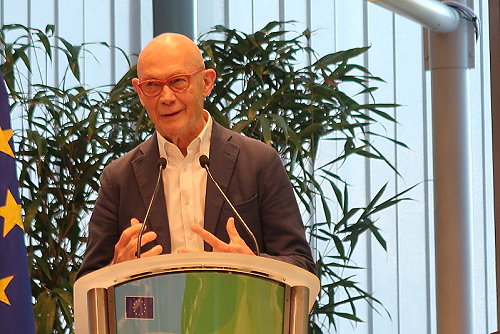 This need for results was echoed by Pascal Lamy, the Mission Board Chair. He noted that the ocean had risen on the EU and international agendas since the launch of the Mission.
But he insisted that now was the time to transform small-scale solutions into large-scale ones, something that would require more high level political energy at national level.
The Ocean Act needed to be as ambitious as the Ocean Pact, and while the Mission investment had leveraged five to nine times of additional financial resources, it was imperative to envisage substantial upscale in funding in the Medium-Term Financial Framework (MFF) for broader success and transformation.
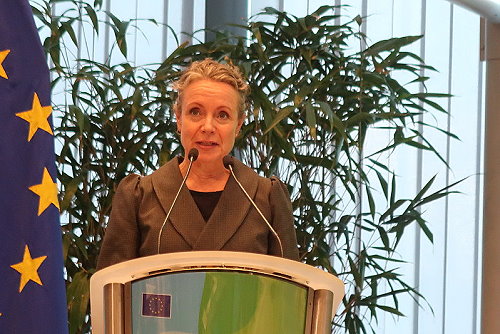 Lotte Worsøe Clausen of the EEA reported that the agency had developed indicators to measure results, particularly in relation to biodiversity protection, zero pollution, and support to the policy on circular economy.
The first results using indicators to assess where we stand, what obstacles are encountered to make necessary changes, and how to overcome these obstacles, showed a reasonable alignment of action with these policies.
The next round of assessments will focus on how well scaling works across all regions of the EU.
The Mission not only produced pilot experiences in a large number of projects, but more than 160 regional authorities were engaging in up-scaling project results. The Director General of DG RTD reported that 16 EU Member States supported the Mission Charter and that €600 million were committed for demonstration sites.
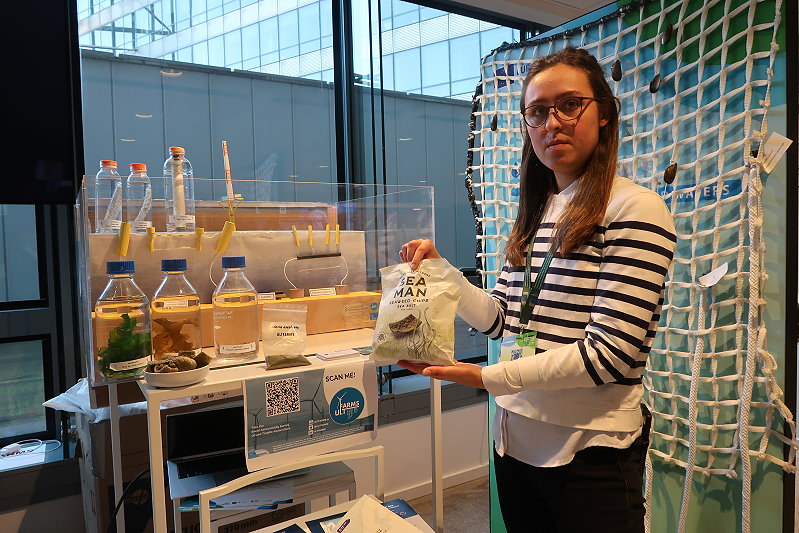
Besides the presentations in the main hall, several projects showed their results, ready for upscaling. Among them the ULTFARM project focused on low trophic aquaculture. They exposed their results in mussel culture, seaweed production and derived products, such as crunchy chips from seaweeds.
Another approach showing promise was diversifying aquaculture production with tourism, citizen science and offering volunteering opportunities as nature guides during summer months.
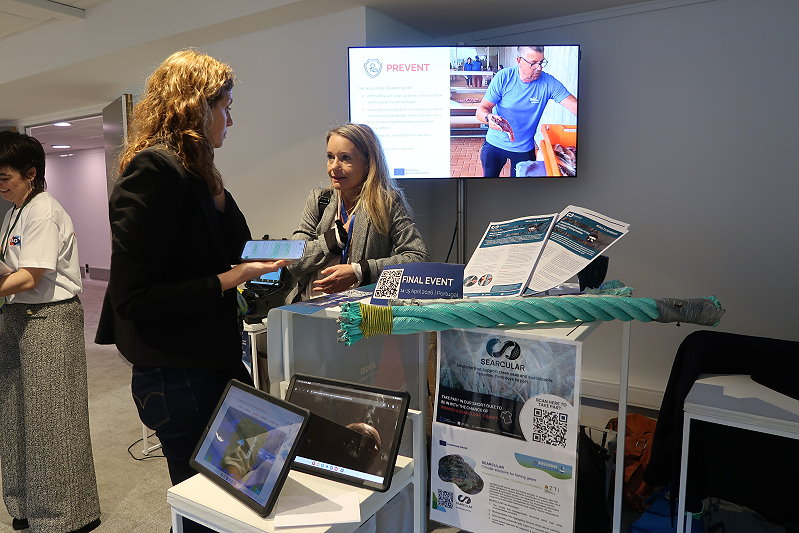
Exploring opportunities in the circular economy was at the heart of another project focused on upcycling discarded plastic. The project team showed a number of options for which they had researched conditions and delivered a proof of principle. They were now looking towards cooperation for turning the pilot into a start-up. Several other projects also showed their results aware that the road from a research innovation towards a viable business can be stony. Given that many research and pilot projects are delivering results, there could have been many more cases exposed in both venues.
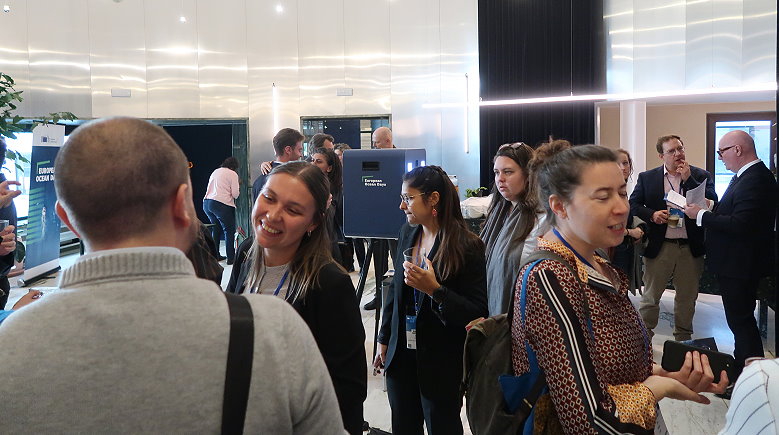
All in all, the EU Ocean Days were a very good opportunity to network and learn from one another. The EU should be commended for offering this visibility for the ocean and opportunity for dialogue. The organisation, generously catered and naturally tilted to European institutional voices, still left room for improvement in future editions. Black Sea voices were very scant and far between this time, Baltic voices dominated strongly by Finland, small-scale fishers accounting for some 70% of the work force were nowhere to be seen even though they have a strong and articulate representation through the LIFE Platform, the Low Impact Fishers of Europe, even though together with supportive civil society organisations, they published a vision and concrete proposals for how to rethink healthy and prosperous fisheries in the future.
A conspicuous void in the agenda was the Ocean Fund to lend credibility to the forthcoming Ocean Act. That Ocean Act should operationalise the aspirational Ocean Pact published last year. Yet especially senior Commission representatives were almost mute on implementation during the entire week. Should this be the result of the Commission President focussing at the opening on the OceanEye – all observation and surveillance – but not speaking to the enforcement of the good already existing laws, regulations and how best to operationalise the Ocean Act?
All the same, it should be recognised that Europe has come quite some way to recognise the importance of the ocean. It’s now also up to citizens, elected parlamentarians, and different affected organisations to participate constructively in the ongoing consultation processes. These must provide guidance towards a transformative Ocean Act that puts us on a strong regenerative course so that we give back to the ocean to continue benefitting from its products and services in line with the responsibility for what has been dubbed the largest Exclusive Economic Zone (EEZ) of any country/region. Regenerating ecosystems in poor state is also an insurance policy against more climate disasters and should be part of the now greater emphasis on security and safety. So, there is work to do together to bring the different capacities and perspectives to bear on robust solutions. All hands are needed on deck. Mundus maris will continue its support for cooperation towards a healthy ocean and thriving coastal communities.
Text and pictures by CE Nauen of Mundus maris.