World Food Day, 16 October, is celebrated around the globe. This year’s motto is ‘Innovate today, harvest tomorrow’. It highlights the need for investing into resilient, equitable food systems for a growing population.
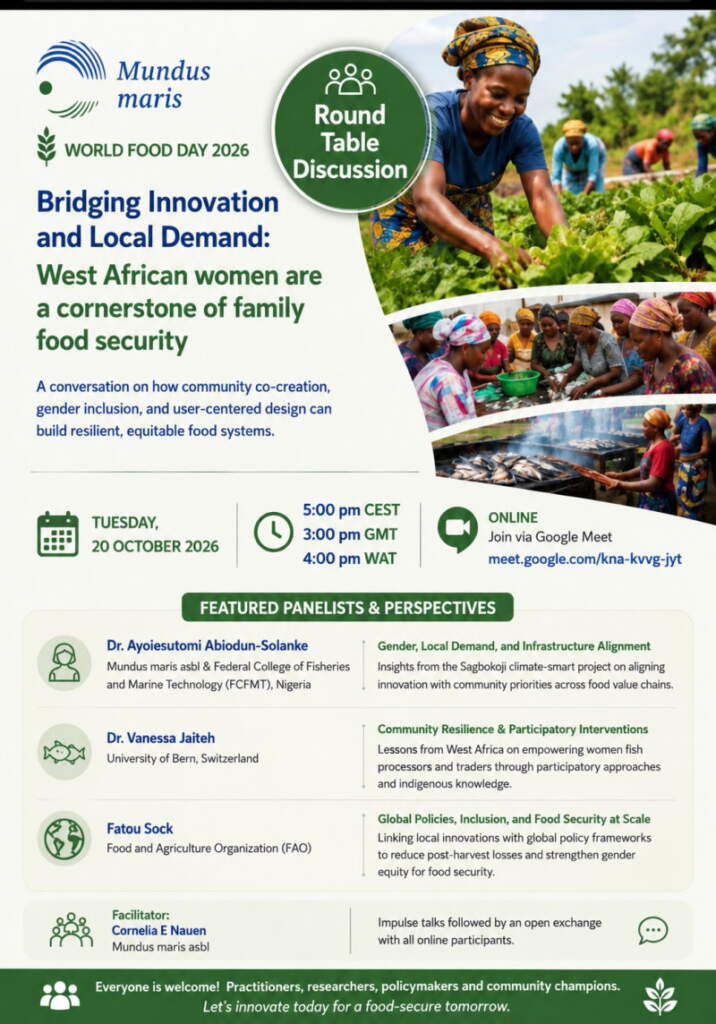
Mundus maris organised an online round table discussion on Tuesday, 20 October 2026, from 5 pm to 6 pm (CEST) under the title “Bridging Innovation and Local Demand. West African women as a cornerstone of family food security.”
Across West Africa, small-scale food producers, processors and retailers -whether in agriculture or fisheries- are predominantly women. They are on the front lines of climate impacts and food security. However, technological and policy interventions frequently underperform when top-down designs fail to align with local socioeconomic realities. This round table brought together food security leaders to discuss how community co-creation, gender inclusion, and user-centered design are essential to making agricultural and aquatic food systems fit for purpose. The impulse talks were followed by an open exchange with all online participants.
Cornelia E Nauen of Mundus maris opened the round table reminding the audience of the key findings a recent global study that investigated how food insecurity could be decoupled from shocks. Key factors are:
 effectiveness of within-country governance,
- food-supply redundancy,
- incomes, and
- capacity strengthening of citizens, particularly of women – what economists call social capital.
The 2021 UN Food System Summit had already identified the need to bring diverse voices to the decision making table, not only for food production practices, but also for post-harvest improvements, consumption patterns and diets. The annual global Food Security and Nutrition Report showed around 645 million people were still affected by hunger in 2025. While still an enormous number of humans without sufficient access to food, this represented a reduction of nearly 14 million compared to 2024 and 43 million compared to 2022.
Closer to home, as we focus on West African women in fish processing and marketing in ensuring food security at the family level. We note that Mauritania has among the highest number of fishmeal factories, which still reduce a disproportionate share of food grade fish into fishmeal and oil for export. This needs to be addressed. Affordable and culturally adapted food must trump feed.
Featured Panelists & Perspective Focus
Gender, Local Demand, and Infrastructure Alignment – Dr. Ayojesutomi Abiodun-Solanke (Mundus maris asbl, and Federal College of Fisheries and Marine Technologies (FCFMT), Nigeria).
Perspective: Using the Sagbokoji climate-smart project as a case study to demonstrate how community adaptation, gender-driven priorities, and user-centered design prevent «intervention mismatches» across local food value chains.
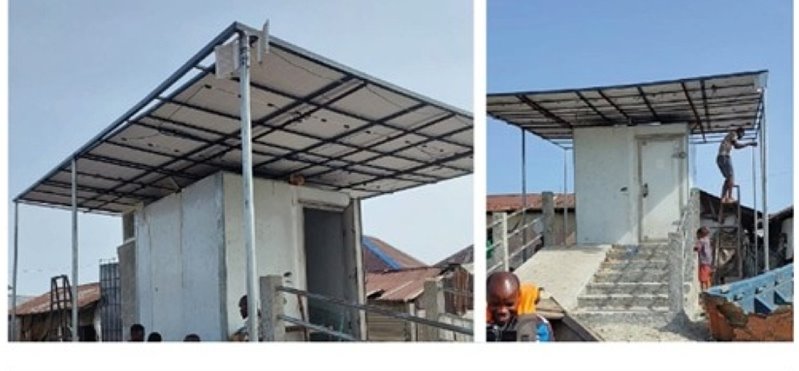
Solar-powered cold room, intended to preserve fish fresh in Sagbokoji, Lagos, Nigeria (Photo courtesy Tomi Solanke)
Tomi showed that the solar-powered cold room financed by a development project, was only used as a general store because the women fish traders needed flake ice to keep the fish fresh while traveling to market places and selling the fresh product in the hot conditions of Lagos, Nigeria. They had no use for a cold store. Listening more carefully to what the women identified as priority needs must pave the way for well targeted and accepted innovation.
Community Resilience & Participatory Interventions in West Africa – Dr. Vanessa Jaiteh (University of Bern, Switzerland).
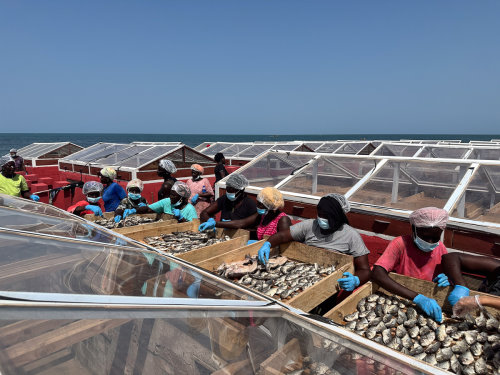
Solar fish dryers in The Gambia. The women are obliged to work under the burning sun (Photo courtesy Vanessa Jaiteh)
Perspective: Impressions from field-level projects in West Africa on the living and working conditions of women (and men) fish processors and traders, integrating local perspectives, and promoting livelihood frameworks with improved working conditions. She found that people may disregard potential risks of ingesting PAHs (polycyclic aromatic hydrocarbons) to get the taste they prefer in smoked fish. Local practices and preferences can vary dramatically from what Western consumers may be used to.
One of the examples showed a new FAO project in The Gambia to scale up hygienic solar fish drying. Strangely, everything was done and no expense spared for preventing insect infestation, but nobody seemed to have thought about what it meant for the women to wear headgear, mouth protection and gloves under the burning sun without any shade. In addition they were required to handle big wooden trays, which were already very heavy without a charge of fresh fish. Shouldn’t it be normal to think healthy fish and healthy women together?
Global Policies, Inclusion, and Food Security at Scale – Fatou Sock (Food and Agriculture Organization – FAO).
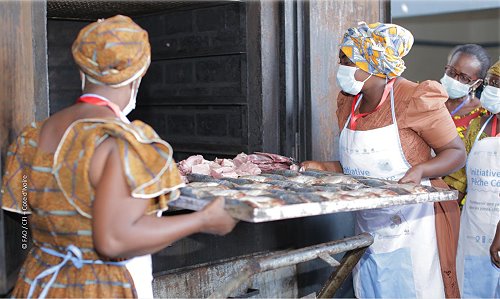
Photo courtesy FAO/CFI Côte d’Ivoire
Perspective: Aligning local food innovations with global policy frameworks (e.g., FAO guidelines) to strengthen gender equity, reduce post-harvest losses, and ensure sustainable food security for smallholder communities. Among others, she shared some experiences from her time as coordinator of the GEF-financed Coastal Fisheries Initiative (CFI). To strengthen the capacities of small-scale fisher women particularly in Senegal, Cape Verde and Côte d’Ivoire, CFI West Africa carried out training workshops for the benefit of 181 actors on gender equality, fish smoking technology with FTT ovens, and access to market and credit in Côte d’Ivoire. Following the workshops, the women were able to integrate the National Union of Cooperative Societies and the National Federation of Cooperative Societies, which includes 22 women’s organizations who operate in the fisheries sector.
Fatou also highlighted that while food insecurity in Africa showed brief improvements in 2025, that progress was not sustained in 2026. Per capita fish consumption in Africa has dropped to 9.1 kg per person and year in 2026— the lowest globally, while the world average sits at around 21 kg per person!
She concluded that the FAO is ready and eager to collaborate with Mundus maris on implementing Ecosystem Approaches to Fisheries (EAF), the Voluntary SSF Guidelines, and voluntary fisheries contributions, stressing that strengthened multi-actor collaboration is the most critical tool for moving forward.
Key Outcome at the end of the debate:
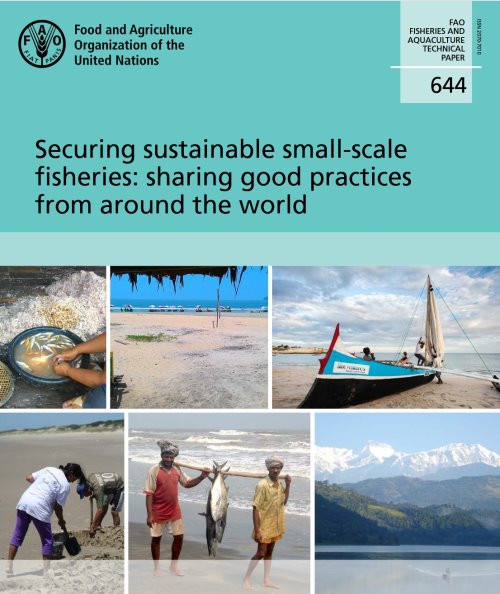
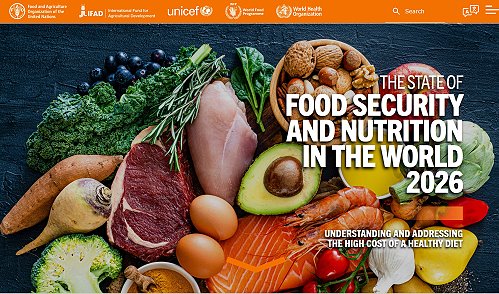
Click on the facsimile of the cover page to download the full report.
Dr. Aliou Sall of Mundus maris Senegal, in his intervention during the debate, emphasised the importance of the ‘Voluntary Guidelines for Ensuring Sustainable Small-Scale Fisheries in the context of food security and poverty eradication’, as adopted in 2014 by the FAO’s Committee of Fisheries (COFI). The guidelines provide an excellent framework for prioritising affordable fish food over animal feed for export. Helas, 12 years later, the implementation gap is huge and needed to be prioritised to bring about greater food security in small-scale fisheries.
Dr Foluke Areola also commented emphasizing the urgent need to protect artisanal fishing zones from industrial trawl incursions in Nigerian waters, highlighting how illegal fishing directly deprives women processors of access to small pelagics (Sardinella maderensis) and undermines local post-harvest trade networks. She called for legal recognition of customary tenure rights and structured financial support for women-led post-harvest cooperatives.
By way of conclusion, we can say, celebrating World Food Day must extend beyond high-level policy dialogue to action on the beach: by honoring customary rights, bridging global frameworks with local knowledge and centering women processors as decision-makers, we can transform West Africa’s small-scale fisheries into resilient engines of food security and social justice.
Los mariscos que comemos
- Mundus maris organises Web Roundtable for World Food Day 2026
- ScientiFRIKA 2026 provides insights in the safety of artisanal fish food production
- Win Big – Baltic Event
- World Food Day 2024, Joint Webinar with Fish Party
- Relator Especial de la ONU sobre el derecho a la alimentación
- Audiencia del Parlamento Europeo sobre la iniciativa ciudadana de la UE para detener el corte de aletas de tiburones
- Keynote at the ‘Feed the Future – Innovation Lab for Fish’
- Seminario web de la FAO ‘Peces pequeños y de bajo coste: del cebo al plato’, 15-16/02/2021
- Disfrute de deliciosos y sostenibles pescados y mariscos con los talleres de Mundus maris
- Chiloé, o: Los desastres de Salmonopoly
- Seafood Symposium – From Fisheries to Foodies, 27 April 2015
- Baltic students concerned about sustainable foods, Rogow, Poland, 15-19 April 2015
- From plates to fuel – the controversial seaweed boom in Chile
- Khazan – Traditional coastal zone management in Goa, India
- Environmentally conscious consumer behaviour in food – what can I do?
- Save baby fish or Point ‘n’ kill?
- “Inseparable” – Fish sustainability campaign celebrates event in Athens
- Respetar la talla mínima de los peces ¿Qué dicen los comerciantes de pescado en el Senegal?
- The Mundus maris campaign in the urban markets in Dakar
- Mercado San Miguel in Central Madrid