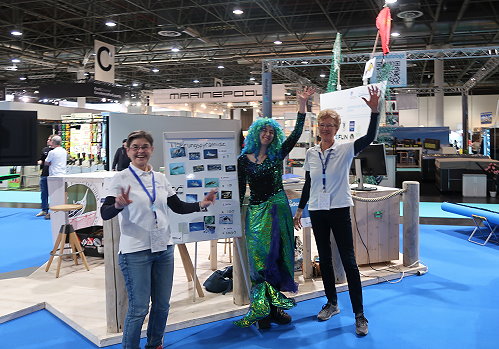
 Together with nearly 100 other enthusiasts of ocean protection, Mundus maris contributed with an expanded programme to the ‚Love Your Ocean‘ platform at the Boot 2026 fair in Düsseldorf, Germany, coordinated by the German Ocean Foundation. During nine days, from 17 to 25 January 2026 the platform attracted huge crowds particularly during the two weekends.
The opening day was particularly symbolic as Saturday, 17 January 2026 marked the entry into force of the BBNJ Treaty, 120 days after the 60th country hat ratified it and after 15 long years of negotiations ending successfully in 2023. It has potential to stop the ongoing mass extinction of species, particularly in the ocean. This Treaty it is the third legally binding agreement under the Law of the Sea and focuses on ending the ‚wild west‘ of the ocean by setting rules to protect biodiversity in areas outside national jurisdiction. The commitment to protect 30% of the global ocean by 2030 is thus edging forward. Protecting 61% of the ocean will have regenerative effects also on coastal countries‘ exclusive economic zones (EEZ).
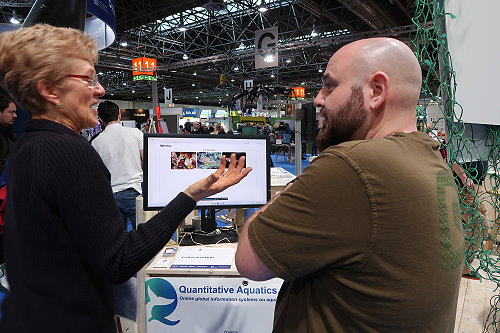 Our partner Quantitative Aquatics, or Q-quatics for short, ia the science non-profit organisation based in the Philippines, which hosts and continuously develops global biodiversity information systems. FishBase is the most developed, now covering information on 36,400 species of freshwater and marine fish. More than 35 year of constant collaborative work provides what most consider now part of the knowledge infrastructure. The best: it is freely available.
We presented Q-quatics‘ greatly enhanced version of the FishS9und Quiz. Three beautiful fish fotos are shown and participants are invited to guess, if they don’t know, which of the three make that sort of knocking, bumping, clicking or other unusual noise. In the foto to the right, Claudia Mense, Mundus maris chief organiser, explains the basics. Once the right species is identified, explanations are provided with which organ, such as the swim bladder or pharyngeal teeth they produce the sounds. The illustration of the fish interior prepared by Aque Atanacio of Q-quatics greatly helped in understanding.
Some kids had a particularly steep learn curve. They quickly identified e.g. the individuals of the grunt family with similar body shapes and were delighted to learn that they could continue playing at home.
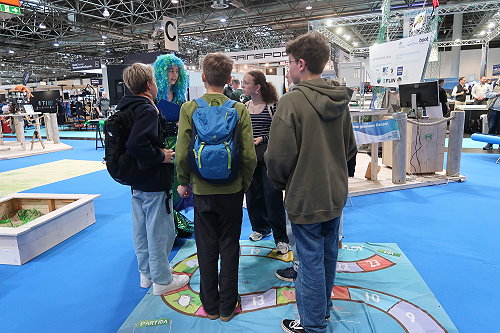 Mundus maris‚ mermaid and other helpers also moderated the Ocean Quiz, which was again particularly popular with the younger generation. During the week, school classes made a stint to catch as much as possible of the many interesting offers on the ‚Love Your Ocean‘ platform.
All questions by age group had been reviewed to not only ask for simple facts, but open conversations about what goes on in the ocean. Again, quite a few young people demonstrated being informed thanks also to the fascinating documentaries screened on tv or on YouTube. The interest was clearly there. It would be great to lend more attention to the ocean which provides us with every second breath of oxygen and has so far prevented much harsher effects of climate change.
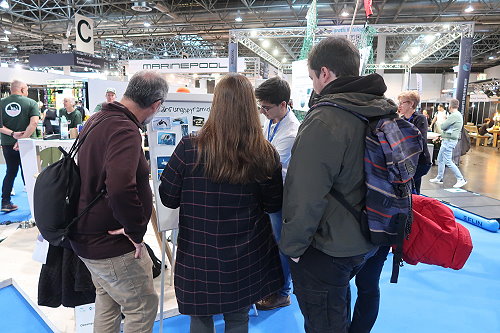 One of the novelties we brought to Boot 2026 was the food pyramid in the ocean. Who eats whom and how does it work. Here supporter Deniz Karagoz explains why gas exchange in the dense medium of what is particularly energy intensive. In practice that means that from the plant producers at the bottom of pyramid only 10% of biomass or energy can be used by the next level, such as zooplankton and fish larvae.
They in term are the principal food for small pelagic schooling fish, like sardines, herring, sardinellas, mackerels, and anchovies. And who feeds on the ’small pelagics‘? Apart from being excellent food for humans, seabirds and bigger fish their abundance makes them targets for the biggest marine fish and mammals.
Indeed, the biggest animals can only find enough food to grow to their enormous size and bodyweight because they feed relatively low in the food web. Top predators, like orcas and many sharks, albeit impressive animals, are nowhere near as numerous as their prey lower in the food web.
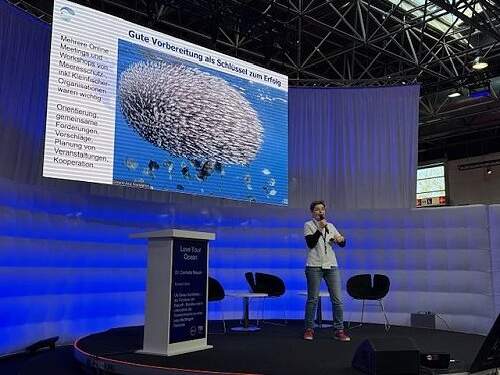 Aside from the busy interactions at the stand, Cornelia Nauen of Mundus maris offered three talks at the Water Pixel World stage. The first took the audience back to June 2025 to the UN Ocean Conference in Nice, France, and even to the preparatory public consultations in 2024. The message was clear, even small organisation with good ideas can meaningfully participate in a global even. Good preparation and collaboration with others is more important than only size.
The second talk illustrated that convincingly by making a comparison between the marginal participation of small-scale fishers at the previous UN Ocean Conference 2022 and their strong showing in collaboration with environmental researchers and others at UNOC3 in Nice. Thanks to systematic international cooperation and with the help of the Costa Rican co-host, they staged a fantastic event in Blue Zone reserved for government representative.
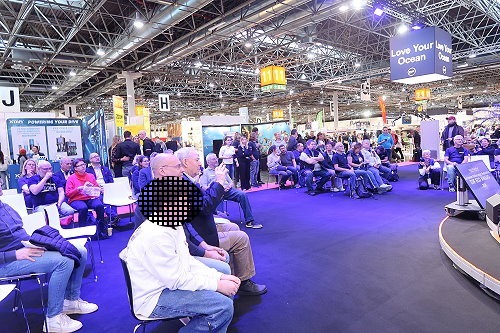 They rightfully claimed to be at the centre of ocean governance given that they contribute more than 25% of global quality fish supply. It was made crystal-clear though that if high tech industrial vessels competing directly with the artisans of the sea, the imbalance was untenable.
Last but not least, we spoke about the EU Ocean Pact, announced at UNOC3, but which needs to be followed up by an Ocean Act so that political declarations lead to tangible improvements of European marine waters and beyond. The currently open public consultation is an opportunity to make your voice heard and contribute your experience. Low hanging apples for participation are also signing the EU Charter ‚Restore our Ocean and Waters‘ and making a commitment towards achieving the goals, at whatever scale. Mundus maris has signed the charter and commits to offer more people a possibility to become active, e.g. through the role play ‚Defending Blue Horizons‘. It aims to support constructive dialogue to make a marine protected area work in practice. Check it out by contacting info(@)mundusmaris.org.
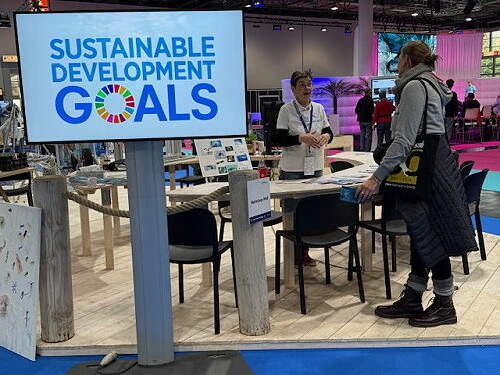 Impossible to narrate all the wonderful conversations, new synergies discovered among projects and initiatives and the sheer dedication of the many actors on the ‚Love Your Ocean‘ floor. Several dive groups cuttings ghost nets from shipwrecks in the Baltic reported that they saw much improvement thanks to their year-long efforts.
At the workshop area the successions of do-it-yourself or educational topics the intense exchange left no doubt that many people are not primarily driven by money – though having some is nice to have – but by serious concerns about how we can help the ocean to regain it former health and productivity.
We heard nobody argue for more high tech industrial vessels that overwhelm nature. We heard many argue for slowing down, concentrate on what is togetherness and quality of life and exercising some self-restraint. They wanted to take out only as much as can regrow in a year’s time, protect baby fish, learn from nature and develop solutions in tune with nature. To us it made a lot of sense to protect the ‚capital‘ in the water and harvest only the ‚interest‘, not consume the capital. Food not only for thought, but for checking the extent to which the regulatory frameworks promote or hinder such approaches.
Mundus maris thanks the many volunteers who helped every day to engage with the public. We carried the message forward about the urgency to regenerate ocean health. We want to continue learning about its wonderful life, keep enjoying the many benefits it provides everyone with, and give back better protection and care.
In general, from the active involvement of the public and the countless good conversations, it is fair to say that the ‚Love Your Ocean‘ platform was the most exciting and engaging part of this vast fair. See you in 2027.