The seventh EU Blue Parks Community workshop was titled ‘From science to practice: co-creating effective MPAs to meet the EU marine protection targets’. It was convened together with the final event of the Blue4all project and as a back-to-back event with the World Conference on Marine Biodiversity, in Bruges, Belgium on 16 November 2026.
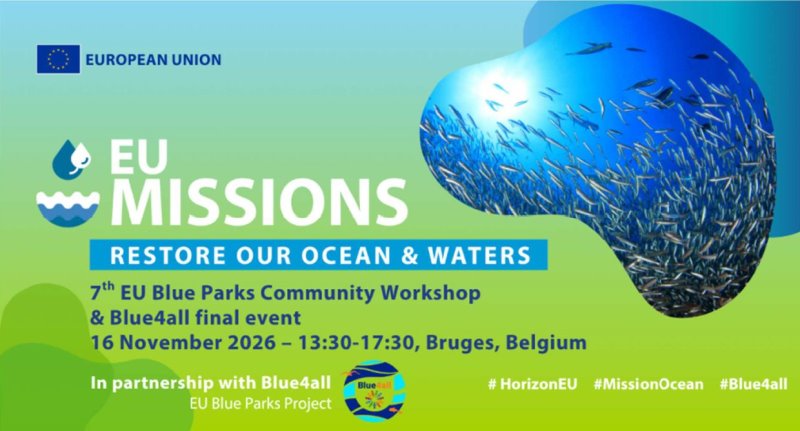
Therefore, the workshop focused very much on lessons learnt and what and how to implement findings from earlier research. As it said in the invitation: „This workshop is designed as an implementation-focused Community event with a deliberately practical central question: what outputs, tools and lessons from EU-funded projects are ready for uptake by MPA managers and authorities – and what does it take to make that uptake happen? The event aims to connect mature EU project outputs with the needs of practitioners and decision makers, while identifying uptake pathways and enabling conditions across sea basins and thus contribute to the success of the EU Mission Restore our Ocean and Waters by 2030.“
The introduction featured a welcome remarks of Andreea Strachinescu Olteanu of DG MARE of the European Commission and a brief overview delivered by Nicola Balbarini of the European Environment Agency (EEA). Nicola painted a sobering picture about the delivery on the targets for protecting 30% or land and sea by 2030. While 13.9% had been declared as protected, the target of 10% of strictly protected areas was missed by a long margin as only 1% would meet the criteria. The assessment based on data from 2024 showed low performances for all parameters assessed:
- existence of a management plan and its effectiveness
- monitoring implementation
- alignment with restoration objectives and the Marine Spatial Planning Directive
- availability of resources for implementation.
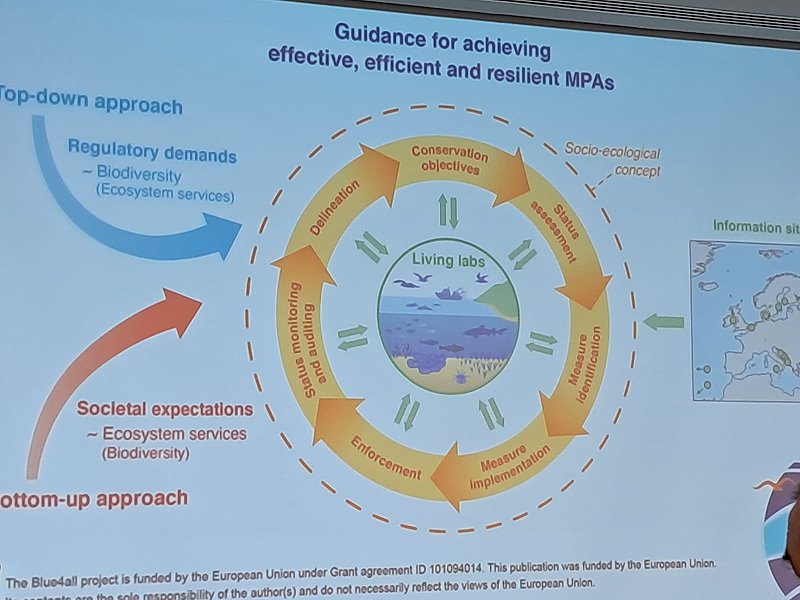
The introductory part was concluded by Steven Degraer of the Royal Belgian Institute of Natural Sciences and team leader of the Blue4All project and Gregory Fuchs of the Ecologic Institute, representing also the Mission Implementation Platform and the EU Blue Parks Community.
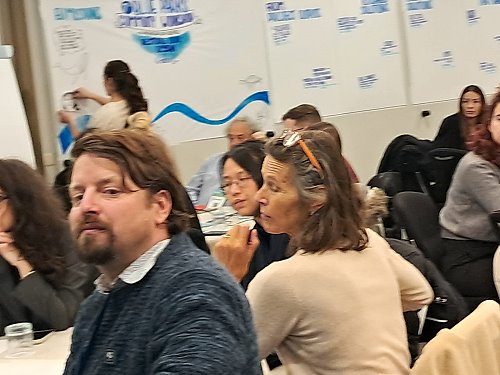 Most of the time of the workshop was dedicated to intense discussions at 9 or 10 tables for up to 8 participants each. Two rounds of table discussions were planned with different emphasis. The table hosts in each round were team leaders from a range of projects focused on marine protected areas (MPAs). They covered quite a range of approaches from developing tools in support of effective management of marine protected areas to related experiential learnings thanks to efforts to co-create an MPA bottom-up. Participants had been invited to chose a table beforehand for each round to be able to discuss MPA.
The rich discussions were also documented in the form of visual recordings (see the photo with visual recording in the background).
Participants took a basic lesson from the introductory presentations into the roundtable conversations about what has been shown to be most useful. Two elements stand out: co-management with as broad a range of stakeholders and rights holders as possible and carrying out regular assessments of effectiveness to provide a learning pathway for improvements. One of the challenges identified by several project participants was that the dominance of English communication in the science world was a major obstacle to wider uptake of lessons and tools in non-Anglophone countries. More resources needed to be allocated to communicate in the national or regional language of each place promoting an effective implementation of an MPA.
The BLUE4ALL project offered the „MPA Solutions Hub: tools and blueprints ready for uptake“ briefly introduced by Sergio Scanu of the Fondazione Centro Euro-Mediterraneo sui cambiamenti climatici (CMCC) and an active member of the BLUE4ALL consortium.
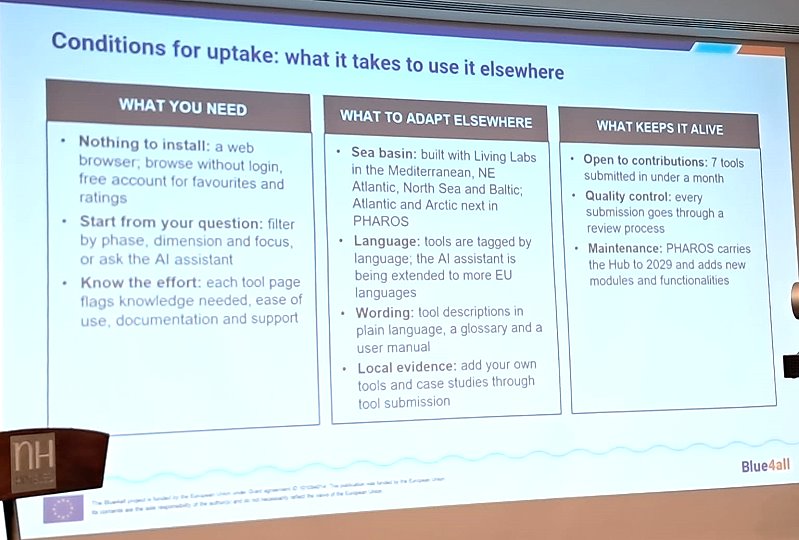
The discussion showed that the three years of the project had been put to good use by providing well structured products aimed primarily as MPA managers. No prior registration is needed to access the package to keep use barriers as low as possible.
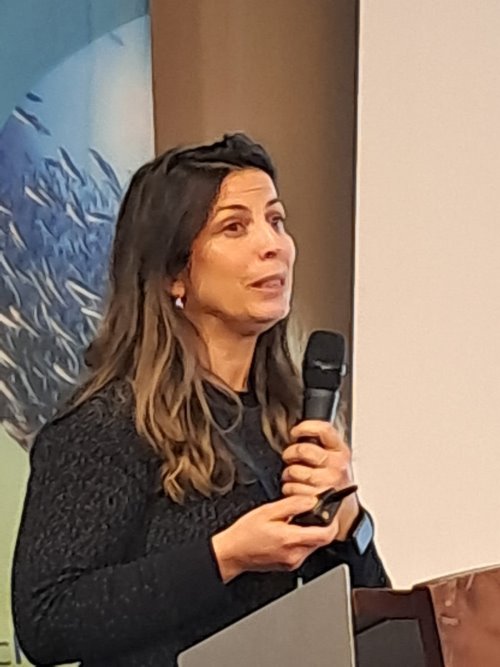
Ana M. Queirós
Ana M. Queirós, Plymouth Marine Laboratory speaking for the ASPACE project spoke to the complementary topic of „Co-creating climate-smart MPAs for nature and people“. Proposing a strongly people-focused approach rather than putting most emphasis on delivering management tools, the project echoed work not only in the UK, but also in several other European countries, each adapted to the specific challenge at hand.
The table discussions offered great opportunities to exchange experiences and teeth out what enhances the chances of success.
Cornelia E Nauen of Mundus maris participated actively and shared some insights from the Small-Scale Fisheries Academy in Ghana. Though outside the EU, the principles teethed out and applied on the inclusive dialogue platform have wider applicability.
A number of these stand out, such as ensuring that all Academy practitioners are treated with respect and without judging anybody. It’s important to develop the dialogue to identify common issues as close as possible to the ground realities of people and focus from the beginning on how to develop activities towards solving at least the ‚low hanging fruits‘.
Women and men from the coastal villages ensure the facilitation of these dialogues and improve step by step through continuous practice, monitor what works well and what can be done differently to achieve greater effects. Templates for reporting are intended to facilitate the peer learning. It’s works in progress as with other project experiences shared.
The workshop offered a great opportunity for mutual learning and fine-tune next steps. A big thank you to the organisers for this productive workshop.
Text and pictures are from Cornelia E Nauen of Mundus maris.