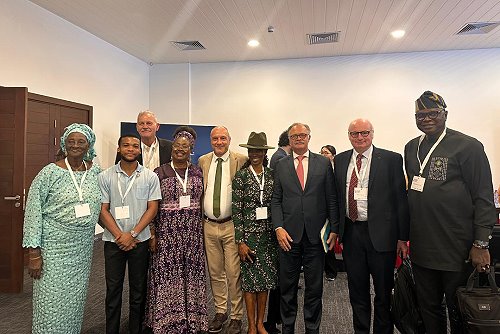
Some participants posing for a group photo, Prof. Stella Williams of Mundus maris to the left, next to Doe Antonio (graduate of the Regional Maritime University, Ghana), Phil Heyl (Project Leader, IMO), Dr. Felicia Chinwe Mogo (AFMESI), Sascha Weh (Chief of Division for Peace Office in Brussels, UNITAR), Mrs Olufunmilayo Olotu (Independent Maritime Analyst and Former Administrator of Port of Calabar and Port of Lagos, Apaps/Chartered Institute of Logistics of Nigeria, CILT), Holger Grebmann (Military Attache, German Embassy to Ghana), Rear Admiral Nuno Bragança (Coordinator, Atlantic Centre), Dr. Abdouralmane Dieng (Head of Regional Security Division, Directorate Peacekeeping & Regional Security, ECOWAS Commission, Abuja)
This was the 2025 conference in the annual series under the subtitle ‚Innovations and Partnerships for the Future‘, last convened in Praia, Cape Verde. Sponsored by the German Federal Foreign Office, UNITAR, the International Maritime Organization (IMO) and the Atlantic Centre, the sessions early December in the capital of Ghana focused on the African Coordinated Maritime Task Force and Presences and on how critical infrastructure could be safeguarded and private sector confidence ensured.
Several innovation labs looked, among others, at how plastic (waste) might be turned back into fuel.
A major topic was the exchange about reforming the Yaoundé Architecture: Progress and Prospects.
The key concern is to continue raising the capacities of the different centres in the Gulf of Guinea and strengthen in operational cooperation (see map here).
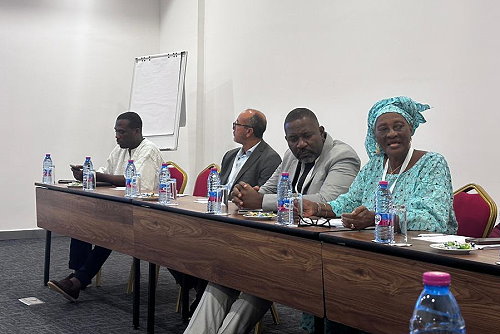
Stella Williams, Vice President of Mundus maris asbl, and Nana Kweigyah, President, Canoe and Fishing Gear Owners Association of Ghana (first to the left), during their presentations titled: Sustainable Fisheries and Local Innovations on Wednesday, 3rd December 2025
The second day laid the emphasis on Communities, Innovation, and Inclusion in Blue Economy and other dimensions on investing in people and their cooperation.
Prof. Stella Williams, Vice President of Mundus maris, spoke on ‚Fisheries Sustainability and Local Innovations‘. She set the scene by citing a research report of Global Fishing Watch (GFW) authors Welch et al. published in Science Advances in 2022 that was based on the AIS dataset of more than 3.7 billion AIS messages of fishing vessel activities between 2017 and 2019. The analysis showed more than 55,000 suspected intentional disabling events in waters more than 50 nautical miles from shore. More than 40% of fishing vessels had suspected disabling events, obscuring up to 6% (>4.9 M hours) of their activity.
Argentina, West Africa and the Northwest Pacific are the three hot spots with the highest incidence of suspected illegal, unregulated, and unrecorded (IUU) fishing. The Sub-Regional Fisheries Commission (SRFC) announced a partnership with GFW in April 2024 and the Gulf of Guinea Regional Fisheries Commission (COREP) agreed to a similar cooperation in June 2024. Among others, it entails analytical support in vessels monitoring and the use of GFW tools for fisheries management.
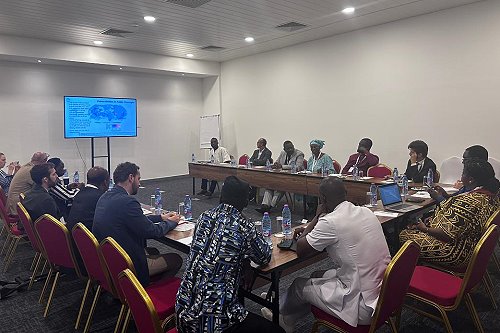 Outlining a few more local examples, Stella argued that some advances were underway, but much more work and cooperation within countries and across the region were still needed. She emphasised that such cooperation must go well beyond partnerships between governments and private enterprises, foreign and domestic, but must engage citizens, civil society organisations, scientists, and youth to build stronger innovative solutions based on equitable benefit sharing. That principle had enabled to bring such a major international agreement as the ‚BBNJ Treaty‘ about ‚Biodiversity in areas Beyond National Jurisdiction‘ to a successful conclusion after years of negotiations.
Small-scale fishers, men and women, seafood traders and directly affected coastal and indigenous communities must be central to marine and coastal governance and foster human security and prosperity. When industrial IUU fishing reduces the ecological and economic basis of their livelihoods, it is not surprising that this is the drop that makes the cup run over. Resource depletion plays an important role for a growing number of people who see no future at home and engage in the perilous irregular migration.
The first successful step towards cutting harmful fisheries subsidies, which mostly go to industrial distance water fleets with high risks of IUU fishing, is the Fish 1 Agreement at the World Trade Organization (WTO). It entered into force on 15 Sept. 2025 after 2/3 of WTO members ratified it. Mundus maris is part of the civil society support to lay foundations to institutional reform for making fisheries sustainable by stopping harmful subsidies at the expense of local SSF and food security.
To see the presentation in full, click here. Mundus maris argues in favour of human rights for human security with emphasis on inclusive governance rather than putting the almost exclusive emphasis on militarising the notion of security and considering migration a priori as illegal and a criminal act. That is not borne out by the circumstances, though criminal gang activity, including IUU fishing, must be fought.
Mundus maris acknowledges gratefully that IMO has sponsored the travel costs of Stella Williams.