This project was carried out in 2025 and 2026 by the Women Shellfish Association’s Ikot Abasi LGA chapter with support from Mundus maris asbl. That support covered funding the advocacy visits, field activities, capacity-building sessions, school outreach and community events. Dr. Atim Okoko delivered the Mundus maris support.
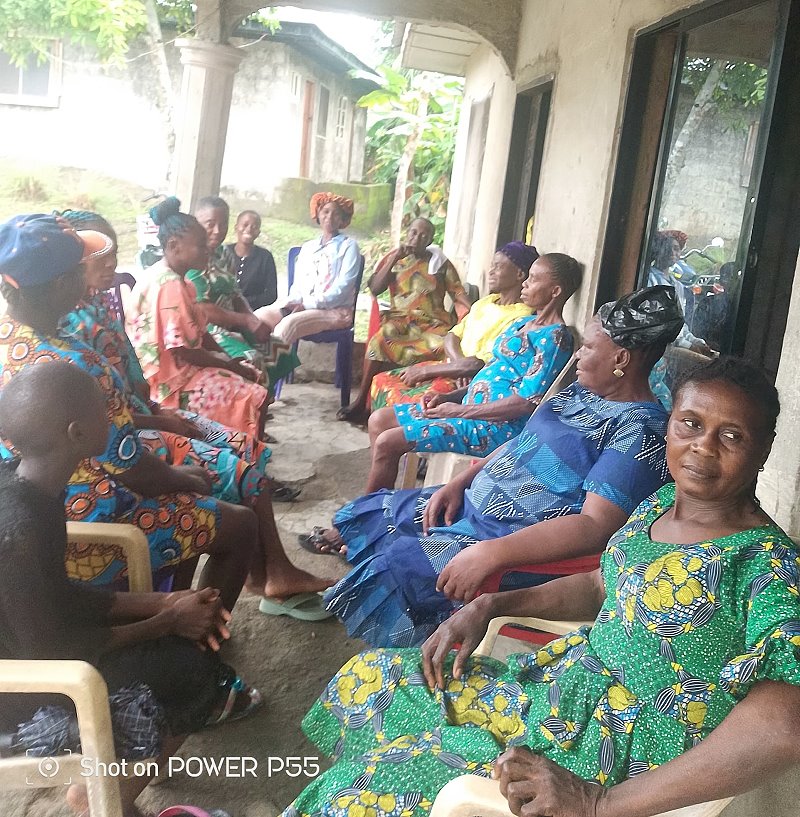
As part of the project activities, the team visited traditional rulers and community leaders to introduce the project and explain why mangrove restoration is important to the communities in the Local Government Area (LGA). During the visits, the team explained the condition of the mangrove environment, the increasing spread of Nypa palm and the need for everyone in the community to play a role in protecting and restoring the mangroves.
The traditional rulers received the team warmly and listened to the concerns raised. Their support was important because they can help encourage other members of the community to participate in the restoration activities.
The team also visited relevant LGA council officials to introduce the project and seek their support for the activities.
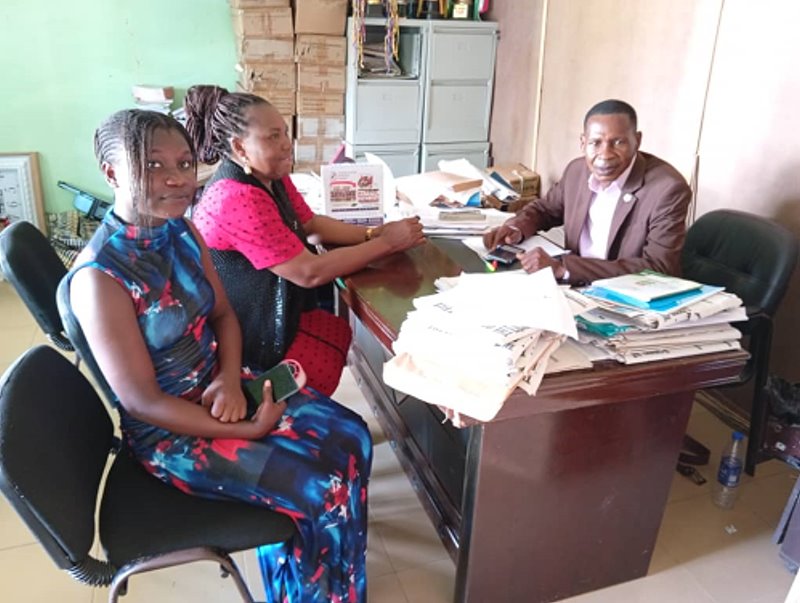
During the discussions, the team explained how mangroves support fishing, shellfish collection and other activities that provide income for people in the community, particularly women. The team also shared some of the challenges affecting the mangrove environment, including degradation and the spread of Nypa palm. The visits helped to establish better communication with the local government and encouraged continued cooperation in supporting the project.
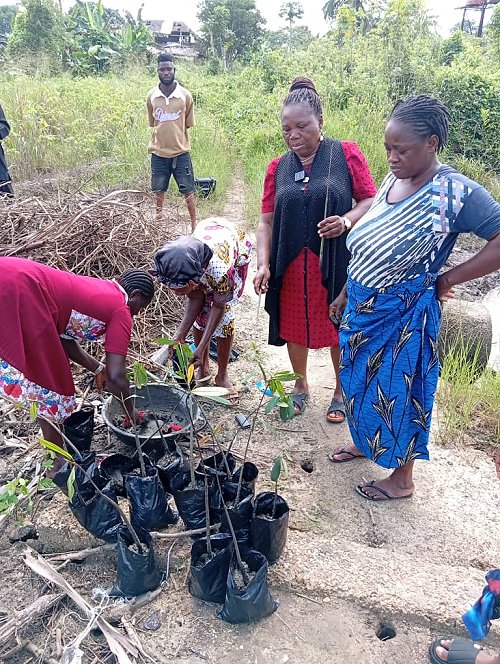 Field activities were carried out as part of our efforts to restore the mangrove environment. Community members and volunteers participated in mangrove restoration work and learned more about the importance of protecting areas where mangroves grow. A pilot mangrove nursery was also established to help provide planting materials for future restoration activities. Participants learned about having healthy planting materials and taking proper care of them before they are transferred to restoration sites.
The spread of Nypa palm was also a major concern. Dr. Okoko discussed with the women the need to control its spread and create more room for mangroves to grow. The fieldwork was particularly useful because participants were able to learn through practical involvement rather than only through discussions.
On the question of replanting versus natural regeneration: the original project design anticipated active replanting across degraded sites, but in practice the pilot nursery was used in a more targeted way, to supply planting material for specific gaps rather than for wholesale replanting, with natural regrowth left to continue elsewhere once Nypa palm encroachment was brought under control. This is the project team’s own interpretation of the approach taken, offered because where mangrove root systems and hydrology are still intact, allowing natural regeneration to proceed is often more effective and less costly than large-scale replanting. This is deduced from the preferences of the women’s own action, not a verbatim account of the women’s reasoning, as they were not separately interviewed on this specific point for the report.
Capacity-building activities were organized for women shellfishers to improve their understanding of mangrove conservation and the sustainable use of coastal resources. The women shared their experiences about how they depend on the mangrove environment for their livelihoods.
The project animators discussed with all participants the importance of protecting mangroves, reducing activities that damage the environment and encouraging women to take an active role in restoration and conservation. The session also gave the women an opportunity to ask remaining questions, share their concerns and learn from one another.
As a result of the project, Conservation Clubs were launched as a way of encouraging continuous community involvement in protecting the environment.
The clubs will help create awareness about mangrove conservation and encourage community members, especially women and youths, to participate in mangrove planting, protection of restoration sites and responsible use of coastal resources. The launch also reminded everybody that conservation should not be left to organizations alone. Everyone in the community has a role to play.
As part of the project activities, Dr Okoko and the Women Shellfish Association leaders also visited a school to create awareness about mangrove conservation, environmental protection and the blue economy.
During the visit, they interacted with the students and introduced them to the importance of mangroves and the role they play in protecting our coastal environment. They explained in simple terms how mangroves provide habitat for fish and other aquatic organisms, protect the coastline and support the livelihoods of people in coastal communities.
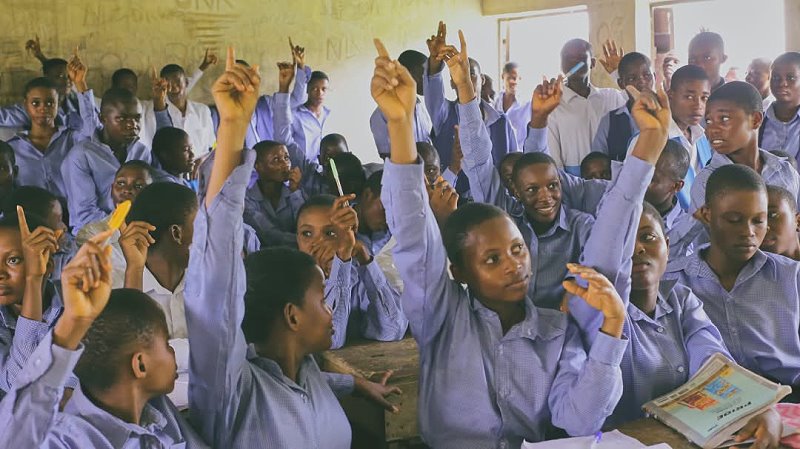
They encouraged the students to develop good environmental habits and to see themselves as part of the future of mangrove conservation. The interaction was lively, and the students had the opportunity to ask questions and share what they already knew about their environment. The school visit was important because we believe that conservation awareness should start early. By involving young people, we are helping to build a new generation that understands the value of mangroves and will be more willing to protect them in the future.
A Community Town Hall and Workshop on Mangroves and the Blue Economy was held to bring community members and other stakeholders together. The programme started with a welcome address and introduction of the purpose of the gathering, followed by a group photograph.
There was a presentation on local technology and sustainable alternatives to fuelwood in mangrove communities. Volunteers engaged the audience with a spoken-word/poetry presentation on mangroves and the blue economy, followed by a speech from the Chairman.
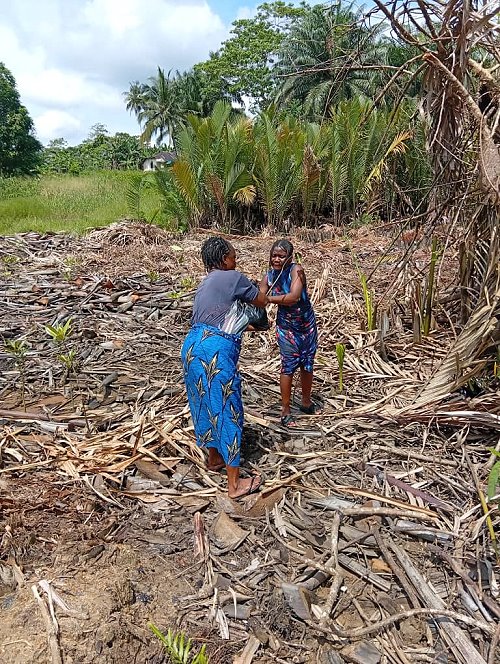
Reducing Nypa palm to make space for natural mangrove regeneration
During the town hall session, we discussed mangroves, fisheries and coastal livelihoods. Local fisherfolk, farmers and youths shared their experiences and talked about the benefits they get from the mangrove environment.
The issue of Nypa palm was also discussed. Participants expressed concerns about its spread and the need to control it so that mangroves can be restored successfully. A question-and-answer session gave community members the opportunity to speak openly and contribute their ideas.
The workshop later focused on local mangrove restoration techniques. The participants launched a Community Mangrove and Blue Economy Pledge. A “Blue Economy Champions” volunteer group was also formed to support awareness creation, conservation and future restoration activities.
The team took pictures throughout the different stages of the project to document the activities and show the involvement of community members and stakeholders. The photographs captured all stages of the project.
The key outcomes of the activities carried out can be summarised as follows:
- Created greater awareness about the importance of mangroves.
- Engaged traditional rulers and community leaders in the restoration initiative.
- Relationship with LGA council officials built.
- Knowledge of women shellfishers about mangrove conservation improved.
- Conservation Clubs launched within the community.
- Students reached through school-based environmental awareness activities.
- Blue Economy Champions volunteer group established.
- Community members and young people encouraged to take greater responsibility for protecting the environment.
- Discussion promoted about sustainable livelihoods and the blue economy.
Overall, the activities showed that successful mangrove restoration requires the participation of the whole community. The Women Shellfish Association and Mundus maris look forward to continuing the work of protecting, restoring and promoting the sustainable use of our mangrove environment.
Text and pictures provided by Precious Bassey, Secretary, Women Shellfish Association, with editorial amendments by Dr. Atim Okoko and Dr Jesutomi Abiodun-Solanke, Mundus maris asbl
Small-Scale Fisheries Academy
- Mundus maris supports the Women Shellfish Association, Ikot Abasi, Nigeria
- Through a Glass Darkly – the EC’s Vision 2040 for Fisheries and Aquaculture
- The SSF Academy convenes the second workshop in Ghana
- Mundus maris presents the SSF Academy in Ghana at the 3rd SSF Summit in Rome
- Restoring Ghana’s fisheries starts with the people who depend on them
- Small-Scale fisheries should be a big part of the future in West Africa
- Plunder in the Atlantic: When Overfishing Threatens the Sea and Coastal Communities
- Our Power, Our Planet – Celebrating Earth Day Webinar
- Mundus maris at EGU26, 3-8 May 2026
- Mundus maris at the aspirational 5th World SSF Summit, Thailand
- Turning a water pest into a source of income
- SSF and Environmentalists rethink fisheries together
- Make Fishing Fair
- Foreign overfishing fuels Senegal’s deadly migration crisis to Europe
- Mundus maris at MARE 2025
- Small-scale fishers at the center of ocean governance and food security
- Make Fishing Fair in the EU, 25 March 2025
- Human – Biodiversity Relationships Across Scales
- World Fisheries Day, 21 November 2024, celebrated in Nigeria
- Mundus maris participated in the 2024 World Fisheries Day organized by Canoe and Fishing Gear Association of Ghana (CaFGOAG).
- Mundus maris contribution to the UNOC3 public consultation
- Small-Scale Fisheries Summit in Rome, 5-7 July 2024
- Regional Symposium on European Small-Scale Fisheries, Larnaca, Cyprus, 1-3 July 2024
- Baltic Fisheries Emergency Meeting, Brussels, 26 June 2024
- Ambivalent role of Market and Technology in the Transitions from Vulnerability to Viability: Nexus in Senegal SSF
- Shell fisheries as stewardship for mangroves
- World Fisheries Day, 21 November 2023
- Webinar: Nigeria’s Fisheries challenges and opportunities
- Presenting the FishBase app at the Symposium in Tervuren
- MARE Conference on Blue Fear – Mundus maris reflects
- The Transition From Vulnerability to Viability Through Illuminating Hidden Harvests, 26 May 2023
- EGU sessions focused on geoethics and joint learning, 23-28 April 2023
- Solidarity with artisanal fishers in Senegal and Mauritania
- The legal instruments for the development of sustainable small-scale fisheries governance in Nigeria, 31 March 2023
- Tools for Gender Analysis: Understanding Vulnerability and Empowerment, 17 February 2023
- Community resilience: A framework for non-traditional field research, 27 January 2023
- Sustainability at scale – V2V November webinar
- African edition of 4WSFC in Cape Town, 21 to 23 November 2022
- European edition of 4WSFC in Malta, 12-14 September 2022
- Mundus maris contributes to SSF Summit in Rome
- Women fish traders in Yoff and Hann, Senegal, victims or shapers of their destiny?
- The Academy continues its work in Yoff
- Illuminating the Hidden Harvest – a snapshot
- Virtual launch event FAO: International Year of Artisanal Fisheries and Aquaculture
- The Small-Scale Fisheries Academy as a source of operational support to PA Guidelines
- World Fisheries Congress, Adelaide, 20-24 September
- Mundus maris supports the fight of Paolo, the fisher, in Tuscany, Italy
- Catching-up – SSF Academy Yoff, 27 Febr. 2021
- Strengthening capacities of the actors for sustainable small-scale fisheries
- Testing training methods during the pilot phase of the SSF Academy in Senegal
- A premiere – launch of a Small-Scale Fisheries Academy in Senegal