 Guest contribution by Brian O’Riordan, Policy Adviser of the Low Impact Fishers of Europe (LIFE Platform).
The European Commission published its “Vision 2040 for Fisheries and Aquaculture” on 20 October. This crystal ball gazing exercise comes at a troubled and turbulent time in European fisheries with considerable uncertainty about the future. The exercise was mandated in Fisheries and Oceans Commissioner Costas Kadis’s 2024 Mission letter, explicitly to prepare a “vision for the fisheries sector with a 2040 perspective” which “tackles the issues that affect the fishing community, supports job creation in the sector and ensures its long-term competitiveness and sustainability”.
According to the Commission’s Vision 2040 Question and Answer page, “the Vision sets a shared direction for building a competitive, resilient and sustainable fisheries and aquaculture sector by 2040. It translates the findings of the evaluation of the Common Fisheries Policy (CFP) Regulation into a strategic vision to overcome these challenges and bring prosperity and new entrants to the sector.”
The Vision 2040 is also framed by a number of important legislative and policy processes, including the EU’s Green Deal 2050 (with its target for a net zero GHG emission economy by 2050) and linked Energy Transition of the Fisheries and Aquaculture Sectors; a 2023 “State of Play” Report on the Common Fisheries Policy; a 2026 Evaluation of the CFP; the publication of an “Ocean Pact” ahead of an “Ocean Act”; an amended Control Regulation and on-going revisions of the Maritime Spatial Planning and Marine Strategy Framework Directives.
Something has changed in the seas: fisheries aren’t what they used to be
Also framing the picture is the “triple planetary crisis”: due to the combined impacts of overfishing, pollution and climate change, European Seas and fisheries are not what they used to be. “Something has changed in the seas”, as one European official put it. There are less fish in the sea than there were – despite significant cutbacks in the fishing sector the last two decades. The recent CFP evaluation highlights that there has been an estimated 10 to 12% reduction in the fishing capacity over the period of the current 2013 CFP. Despite this and a significant reduction of fishing mortality, the number of stocks considered healthy has more or less stabilised at 2014 levels or slightly decreased over the period 2014-2022. Meanwhile fish catches in EU waters have decreased by 8% or 700.000 tonnes over the same period.
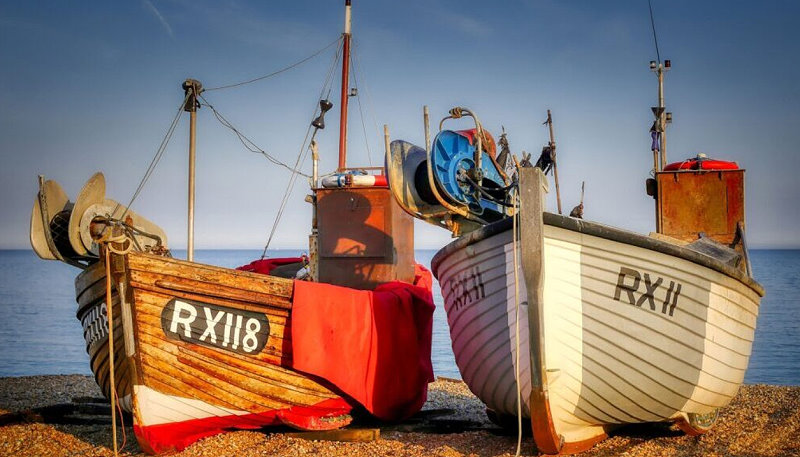
Small wooden fishing boats in the Baltic
To this triple crisis – climate change, biodiversity loss and pollution – can be added a fourth crisis. This is the structural socio-economic injustice of social inequality, historical exploitation, and systemic exclusion of current and future generations driven by global environmental degradation and concentration of wealth and power. In the case of fisheries, the degradation of the marine environment will mostly affect those least responsible – the coastal fisheries dependent communities – who will have to bear the heaviest burdens.
At the same time war in Ukraine and the Gulf Countries is threatening supply chains, creating fuel and other supply shortages, and driving up the costs of energy – a critical cost element – in European fisheries. In short, European fisheries are beset by significant negative externalities and economic and environmental volatility.
For their part, the Low Impact Fishers of Europe (LIFE), a European platform with 40 member associations across 15 countries, incorporating around 10.000 fishers who aspire to minimise their environmental impact whilst maximising their socio-economic contributions has given a warm but measured response to Vision 2040. LIFE was set up during the 2009 to 2013 reform of the CFP, to fill a void at EU level by providing a voice for European small-scale inshore fleets (SSCF), to redress historic wrongs and to make the case for small-scale low impact fishing. This is based on the premise that SSCF could (and should) be part of providing solutions to problems besetting Europe’s ailing seas – as set out in LIFE’s 2024-2029 Manifesto.
It was a shared perspective on European fisheries – that the future has to be low impact and fair – that brought LIFE and the environmental NGO Seas at Risk together to develop a vision for fair low impact fisheries in Europe – aka “Rethinking Fisheries”, published in December 2025.
Rethinking Fisheries: the future of fishing is fair and low impact
“Rethinking Fisheries” contends that the future of fisheries lies in fair, low-carbon, low-impact fishing that brings social, environmental and economic values into balance. It advocates for a structural transformation away from high impact, volume-driven extraction towards “pesco-ecology/ pechecologie” (a marine equivalent of agroecology) and a socially just transition. The Vision 2040 partially absorbs this agenda, explicitly committing to “supporting a fair transition towards more low-impact, climate-neutral activities” while safeguarding food security.
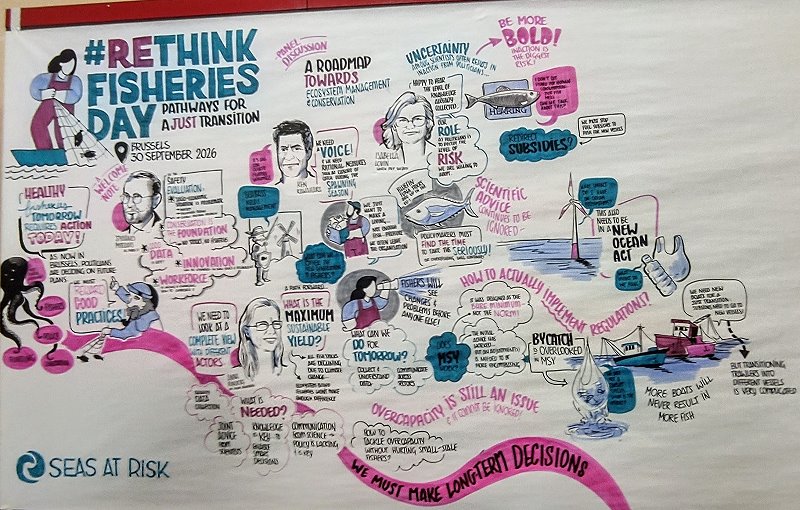
Ahead of the publication of the EC’s Vision 2040, LIFE and Seas at Risk jointly organised “Rethinking Fisheries Day” as part of the “Blue NGO” Ocean Week in Brussels. Ocean Week has become an annual event in Brussels, marking the return to work of EU institutions after the summer break, initiated in 2024. The first Ocean Week coincided with the start of the Xth Legislature, with 720 new European Members of Parliament (MEPs) taking up their seats. Ocean Week has now become an annual event to raise awareness – aimed as much at the general public as EU functionaries and representatives – about the significant issues facing the ocean, the marine environment, and fisheries and aquaculture.
The day-long Rethinking Fisheries event was addressed by several key-note speakers from the European Commission and from experts engaged in fisheries and aquaculture research and policy. 4 panel discussions were organised along thematic lines, attended by over 100 participants.
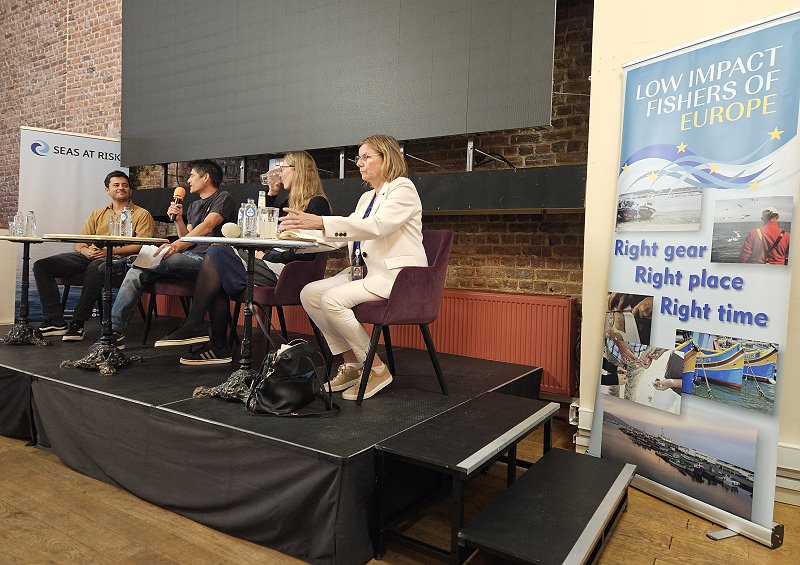
Intense debate during Ocean Week with MEP Isabel Lövin (r) and others
Small-scale fisheries in Europe: what’s in a definition?
Small-scale coastal fishing (SSCF) only became a defined category in European fishing policy in 2006. The European Fisheries Fund (EMFF) identified SSCF as a specific socio-economic category and potential recipient of EU fisheries subsidies, defined as fishing carried out by fishing vessels of an overall length of less than 12 metres and not using towed gear. However, it was only in 2013 that the SSCF was mentioned in the CFP, where Member States are called on “to endeavour to give preferential access for small-scale, artisanal or coastal fishermen” in the 12-mile zone. The EC’s Scientific Technical, Economic Committee on Fisheries (STECF) uses this category to provide social and economic information on the EU fishing fleet in their Annual Economic Report (AER). STECF notes that the main characteristics of the fleet using this definition are: polyvalent, multi-gear and multi-species; operating in an area closest to landing points, usually operating within 12 miles; vessels usually owned by small families or one individual; supports coastal communities, providing employment opportunities and contributing to local economies; and last but not least, many small-scale coastal fishers practice sustainable fishing to preserve fish stocks and maintain ecological balance in coastal areas. They often use selective fishing techniques, avoid overfished species, and minimize bycatch.
However, there are those who find this definition too restrictive and would like to see larger vessels using mobile gears and more industrial practices included. For example, for the purpose of allocating Bluefin tuna quotas, the International Commission for the Conservation of Atlantic Tuna (ICCAT) Recommendation 25-04 defines small scale vessels as those complying with 3 out of 5 of the following criteria: overall length less than 12 m; operating inside the flag state’s territorial waters; trip duration less than 24 hours; maximum of four crew members; or using selective, low-impact gear. This creates a huge loophole for relatively large vessels to fit the definition, and by not defining “selective, low impact gear” ICCAT leave the door wide open for (mis)interpretation.
Ahead of the next EU budget for the period 2028-34, the EPP political group in the European Parliament want to drop the current EC EMFAF definition in favour of the ICCAT one. This would allow EU subsidies earmarked for smaller-scale lower impact socio-economically disadvantaged fleets to be extended to larger vessels using less selective and greater impacting gears. It would potentially extend such subsidies from 70% to 90% of the fleet and risk losing the key attributes that characterise SSCF as lower environmental impact and higher social value.
This has deep implications for the future of SSCF in Europe.
Changing the definition to make subsidies more freely available to larger scale operators, distorting a subsidies policy aimed at creating a level playing field and jettisoning an invaluable fisheries management and analytical tool is not sensible or responsible policy making. Small-scale fishers don’t need redefinition, and certainly not one that threatens the very identity and rationale of this fleet segment and then coastal communities they serve.
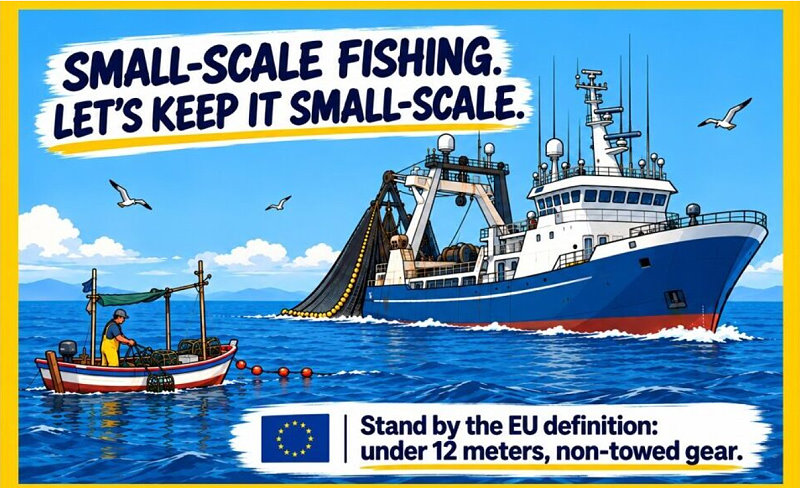
What LIFE calls for in the upcoming Ocean Act is to transform existing principles into enforceable practice by establishing a binding SSCF Plan of Action, ring-fencing low-impact fishing opportunities under Article 17 of the CFP and creating a dedicated SSCF regenerative fishing zone within territorial waters under co-management arrangements to protect coastal and low impact fishing activities from industrial squeezing and noxious impacts.
Europe’s small-scale fishers are often presented as anachronistic relic of the past. They are not. On the contrary, they are part of the solution towards a better future by providing an indispensable foundation for an equitable, low impact, climate-resilient blue economy.
Small-Scale Fisheries Academy
- Through a Glass Darkly – the EC’s Vision 2040 for Fisheries and Aquaculture
- The SSF Academy convenes the second workshop in Ghana
- Mundus maris presents the SSF Academy in Ghana at the 3rd SSF Summit in Rome
- Restoring Ghana’s fisheries starts with the people who depend on them
- Small-Scale fisheries should be a big part of the future in West Africa
- Plunder in the Atlantic: When Overfishing Threatens the Sea and Coastal Communities
- Our Power, Our Planet – Celebrating Earth Day Webinar
- Mundus maris at EGU26, 3-8 May 2026
- Mundus maris at the aspirational 5th World SSF Summit, Thailand
- Turning a water pest into a source of income
- SSF and Environmentalists rethink fisheries together
- Make Fishing Fair
- Foreign overfishing fuels Senegal’s deadly migration crisis to Europe
- Mundus maris at MARE 2025
- Small-scale fishers at the center of ocean governance and food security
- Make Fishing Fair in the EU, 25 March 2025
- Human – Biodiversity Relationships Across Scales
- World Fisheries Day, 21 November 2024, celebrated in Nigeria
- Mundus maris participated in the 2024 World Fisheries Day organized by Canoe and Fishing Gear Association of Ghana (CaFGOAG).
- Mundus maris contribution to the UNOC3 public consultation
- Small-Scale Fisheries Summit in Rome, 5-7 July 2024
- Regional Symposium on European Small-Scale Fisheries, Larnaca, Cyprus, 1-3 July 2024
- Baltic Fisheries Emergency Meeting, Brussels, 26 June 2024
- Ambivalent role of Market and Technology in the Transitions from Vulnerability to Viability: Nexus in Senegal SSF
- Shell fisheries as stewardship for mangroves
- World Fisheries Day, 21 November 2023
- Webinar: Nigeria’s Fisheries challenges and opportunities
- Presenting the FishBase app at the Symposium in Tervuren
- MARE Conference on Blue Fear – Mundus maris reflects
- The Transition From Vulnerability to Viability Through Illuminating Hidden Harvests, 26 May 2023
- EGU sessions focused on geoethics and joint learning, 23-28 April 2023
- Solidarity with artisanal fishers in Senegal and Mauritania
- The legal instruments for the development of sustainable small-scale fisheries governance in Nigeria, 31 March 2023
- Tools for Gender Analysis: Understanding Vulnerability and Empowerment, 17 February 2023
- Community resilience: A framework for non-traditional field research, 27 January 2023
- Sustainability at scale – V2V November webinar
- African edition of 4WSFC in Cape Town, 21 to 23 November 2022
- European edition of 4WSFC in Malta, 12-14 September 2022
- Mundus maris contributes to SSF Summit in Rome
- Women fish traders in Yoff and Hann, Senegal, victims or shapers of their destiny?
- The Academy continues its work in Yoff
- Illuminating the Hidden Harvest – a snapshot
- Virtual launch event FAO: International Year of Artisanal Fisheries and Aquaculture
- The Small-Scale Fisheries Academy as a source of operational support to PA Guidelines
- World Fisheries Congress, Adelaide, 20-24 September
- Mundus maris supports the fight of Paolo, the fisher, in Tuscany, Italy
- Catching-up – SSF Academy Yoff, 27 Febr. 2021
- Strengthening capacities of the actors for sustainable small-scale fisheries
- Testing training methods during the pilot phase of the SSF Academy in Senegal
- A premiere – launch of a Small-Scale Fisheries Academy in Senegal